QUALITECH PUBLIC COMPANY LIMITEDSET: QLT🇹🇭 TH

CG Policy · 2025

Corporate Governance Policy

Has a Corporate Governance Policy

Yes

Policy Description

The Company adheres to systematic management principles and good corporate governance processes as key factors. It has established a good corporate governance policy, which aligns with the Principles of Good Corporate Governance for Listed Companies 2017 (CG Code) all 8 principles, including the Company's written Business Ethics Handbook. This serves as a guideline for directors, executives, employees, and subsidiaries to follow. Furthermore, the Company's corporate governance policy and ethics handbook are regularly updated to be modern, suitable for the business environment, and more international. This also includes additional provisions for reporting misconduct, corruption, violations, or non-compliance with ethics, methods for whistleblowing, providing information, and measures for protecting and ensuring fairness for informants, reporters, complainants, or those who cooperate in reporting such information. These policies are scheduled for review annually, or at least once a year, through the Board of Directors' meeting, with the Company Secretary and Investor Relations Department responsible for communicating and monitoring compliance with the Company's corporate governance policy. The corporate governance policy handbook, as well as various policies and practices, have been reviewed in accordance with the Principles of Good Corporate Governance for Listed Companies 2017 (CG Code), all 8 principles, as follows:

Principle 1 Recognize the roles and responsibilities of directors as organizational leaders who create sustainable value for the business.

Principle 2 Define the main objectives and goals of the business for sustainability

Principle 3 Strengthen an effective board of directors

Principle 4 Recruit and develop senior executives and manage personnel

Principle 5 Promote innovation and responsible business conduct

Principle 6 Ensure appropriate risk management and internal control systems are in place

Principle 7 Maintain financial credibility and information disclosure

Principle 8 Support shareholder engagement and communication

and covers all 4 categories as follows:

1. Shareholders' rights and equitable treatment of shareholders

2. Consideration of stakeholders' roles and business development for sustainability

4. Disclosure and transparency

5. Board responsibilities

Policy & Practices — Board of Directors

Has Policy & Guidelines for the Board

Yes

Board Guidelines

GuidelineOther — Please SpecifyDetail
Nomination of Directors

Policies and Practices Regarding Directors

The Board of Directors comprises qualified individuals with diverse knowledge, abilities, and experience from various professions, including engineering, management, and other fields beneficial to the Company's operations. They maintain independence in decision-making for the utmost benefit of the Company and its shareholders. The Board of Directors participates in defining the Company's vision, mission, ethics, goals, policies, business plans, long-term strategies, and annual budget, entrusting the management to present these. The Board of Directors provides feedback and discusses with the management to achieve mutual agreement, as well as overseeing the management's efficient execution of the business plan and budget. It also ensures regular processes for evaluating the adequacy of internal control systems, financial reporting, and performance monitoring.

In the year 2568 (2025), the Board of Directors Meeting No. 4/2568, held on March 6, 2568 (2025), reviewed the Company's vision, mission, strategies, goals, and business direction, as well as important policies to ensure their suitability and alignment with business operations under good corporate governance principles, such as the corporate governance policy and anti-corruption policy. The Board found them still appropriate for current business operations and assigned the management to implement them and report on their performance at quarterly Board of Directors meetings.

Board Structure

The Company has stipulated that the composition of the Board of Directors must include at least one-third of the total number of directors as independent directors, but not less than 3 persons. These independent directors serve as representatives of minority shareholders, performing duties to audit and balance the Company's various business operations to ensure they are conducted correctly, fairly, and for the utmost benefit of shareholders.

The Board of Directors promotes diversity in its structure, ensuring it comprises qualified individuals with diverse knowledge and abilities, experience, expertise beneficial to business operations, and a commitment to integrity and honesty, without limitations based on gender, race, religion, age, professional skills, or other specific qualifications.

Currently, the Board of Directors consists of 10 qualified members, a number suitable for the Company and effective in performing their duties. It comprises 4 executive directors, 6 non-executive and non-independent directors, and 5 non-executive directors who qualify as independent directors, which is more than one-third of the total Board members.

Audit Committee: The Company has an Audit Committee consisting of 3 independent directors. They perform specific duties and propose matters for the Board of Directors' consideration and acknowledgment. The Audit Committee has rights and duties as defined in its scope of authority and responsibilities. At least 1 audit committee member must possess sufficient accounting knowledge and experience to review the reliability of the Company's financial statements. The audit committee member with knowledge and experience in reviewing the Company's financial statements is:

1. Mr. Tatchapong Thamputthipong

And there is 1 audit committee member with knowledge and experience in the Company's business, namely:

1. Mr. Tatchapong Thamputthipong

The Board of Directors has appointed a Company Secretary to fulfill duties and responsibilities under the Securities and Exchange Act. However, in the future, the Company may establish other sub-committees to perform assigned tasks to alleviate the administrative burden of the Board of Directors.


Board Diversity Policy

The Board of Directors is well aware of the benefits of Board Diversity and considers it a crucial factor in enhancing the efficiency of the Board's decision-making and operations.

The Company has a gender diversity ratio on its Board, with male directors accounting for 60% and female directors for 40%. This diversity is not limited to gender but also includes age, educational background, professional experience, skills, and knowledge. Therefore, the nomination and appointment of company directors will be based on knowledge and abilities, using selection criteria that consider the benefits of diversity.

As of December 31, 2568 (2025), the Board of Directors consists of a total of 10 members, who are generally recognized as capable individuals. They possess diversity in gender, skills, professions, expertise, and experience beneficial to the execution of business strategies and the Company's success.

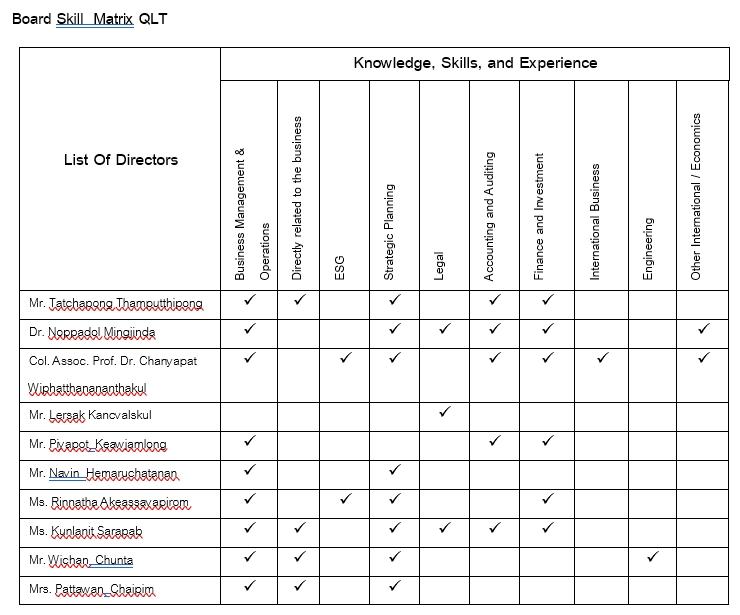
The directors possess skills aligned with the company's business strategy, as detailed in the Board Skills Matrix, and demonstrate diversity in education and experience, without any other limitations. The Board Skills Matrix can be summarized as follows:

Nevertheless, the Board of Directors still mandates that each year, at least three-fourths of all directors must attend training to develop and enhance their knowledge, understanding, and roles as directors, as well as other courses related to maintaining their status as company directors and in sub-committees. The goal is for all directors to have knowledge of ESG, which is a concept for sustainable organizational development, as it is a policy that the Company prioritizes. In the past year 2568 (2025), two directors completed ESG training and gained ESG knowledge. The Company aims to further promote directors' knowledge in AI and information technology by the year 2570 (2027).

Term of Office for Directors

At every Annual General Meeting of Shareholders, one-third, or the number closest to one-third, of the directors in office at that time shall retire. A retiring director may be considered for re-nomination to the shareholders' meeting for re-election to office.

For audit committee members, each audit committee member shall serve a term of 3 years. An audit committee member whose term expires in accordance with the Company's regulations may be reappointed. In the event that an audit committee position becomes vacant for any reason other than the expiration of the term, the Board of Directors shall appoint a qualified person as an audit committee member to ensure the number of audit committee members meets the Board's requirements. The person appointed as a replacement audit committee member may only serve for the remainder of the term of the audit committee member they are replacing.

The Company has established qualifications for individuals to serve as truly independent directors, suitable for the Company's specific characteristics. This independence must comply with the criteria set by the SEC and the Stock Exchange of Thailand. The Company stipulates that independent directors may serve for a continuous term not exceeding 9 years from the date of their initial appointment as independent directors.

To ensure clarity in roles and responsibilities, the Company has clearly defined the duties of the Chairman and directors, to prevent any single individual from having unlimited authority. The person holding the position of Chairman is separated from the person holding the position of Chief Executive Officer, and an independent director is designated to hold the position of Chairman. As of the year 2568 (2025), no independent director has served for more than 9 years.

Nomination and Appointment of Directors and Top Executives

Nomination and Appointment of Independent Directors

The Company has defined independent directors in accordance with the minimum requirements of the Securities and Exchange Commission and the Stock Exchange of Thailand, as per the Capital Market Supervisory Board Notification No. TorJor. 4/2552 dated February 20, 2552, regarding the qualifications of independent directors, namely:

An Independent Director refers to an external director who is independent in expressing opinions, acts to protect the interests of all shareholders equally, and can help prevent transactions involving conflicts of interest between the Company and related persons. The qualifications for holding the position are as follows:

1. Holding shares not exceeding 1% of the total voting shares of the Company, its subsidiaries, major shareholders, or controlling persons of the Company. This includes shares held by related persons of that independent director.

2. Not being or having been a director involved in management, an employee, a salaried advisor, or a controlling person of the Company, its subsidiaries, major shareholders, or controlling persons of the Company, unless such characteristics have ceased for at least 2 years.

3. Not being a person related by blood or legal registration as a father, mother, spouse, sibling, or child, including the spouse of a child of another director, executive, major shareholder, controlling person, or a person to be nominated as a director, executive, or controlling person of the Company or its subsidiaries.

4. Not having or having had a business relationship with the Company, its subsidiaries, major shareholders, or controlling persons of the Company in a manner that may impede their independent judgment, and not being or having been a significant shareholder or controlling person of those having a business relationship with the Company, its subsidiaries, major shareholders, or controlling persons of the Company, unless such characteristics have ceased for at least 2 years.

5. Not being or having been an auditor of the Company, its subsidiaries, major shareholders, or controlling persons of the Company, and not being a significant shareholder, controlling person, or partner of an auditing firm to which an auditor of the Company, its subsidiaries, major shareholders, or controlling persons of the Company belongs, unless such characteristics have ceased for at least 2 years.

6. Not being or having been a professional service provider, including legal or financial advisors, who received service fees exceeding 2 million Baht per year from the Company, its subsidiaries, major shareholders, or controlling persons of the Company, and not being a significant shareholder, controlling person, or partner of such professional service provider, unless such characteristics have ceased for at least 2 years.

7. Not being a director appointed as a representative of a director of the Company, a major shareholder, or a shareholder related to a major shareholder.

8. Not engaging in a business of the same nature that significantly competes with the business of the Company or its subsidiaries, or not being a significant partner in a partnership, or a director involved in the management of employees, salaried advisors, or holding more than 1% of the total voting shares of another company that engages in a business of the same nature and significantly competes with the business of the Company or its subsidiaries.

9. Possessing no other characteristics that would prevent them from providing independent opinions regarding the Company's operations.

After being appointed as an independent director with characteristics conforming to clauses 1 to 9, the independent director may be assigned by the Board of Directors to make decisions regarding the operations of the Company, its parent company, subsidiaries, associated companies, fellow subsidiaries, major shareholders, or controlling persons of the Company, through collective decision-making.

The Board of Directors comprises 5 independent directors, who are knowledgeable, capable individuals, and genuinely independent in performing their duties, for example, having no business relationship with the Company and no other relationships that could influence their independent judgment and performance of duties.

Term of Office for Independent Directors

The Board of Directors stipulates that independent directors shall serve a term of 3 years, with one-third of the total number of directors rotating out of office at each term's expiration. Upon completion of their term, directors may be considered for re-nomination to the Annual General Meeting of Shareholders for re-election as company directors and may return to office. However, independent directors may serve for a maximum of 3 terms or 9 years, calculated from the date of their appointment and the Company's listing on the Stock Exchange. As of the year 2568 (2025), no independent director of the Company has served for more than 9 years.

Nomination and Appointment of Directors and Top Executives

The nomination of qualified individuals to serve as directors whose terms have expired or in other cases is proposed to the Board of Directors for consideration of the nominated individuals for election and submission to shareholders for approval. The Company's selection process for qualified individuals is based on expertise, vision, leadership, integrity, transparent work history, and the ability to express independent opinions. The selection of individuals for directorship must align with the Company's business strategies. The Company has prepared a Board Skill Matrix to support the consideration of director nominations, focusing on necessary knowledge and expertise currently lacking on the Board. The Board will consider qualified individuals for directorship from nominations by shareholders for election as directors, nominations by external consultants (Professional Search Firm), nominations from a Director Pool database, or nominations through other processes deemed appropriate by the Board.

The current directors of the Company, who have been nominated, are aligned with the Company's business strategies.

The composition, nomination, appointment, removal, or termination of directorships of the Company are stipulated in the Company's Articles of Association, the key points of which can be summarized as follows:

1. The Board of Directors shall consist of no less than 7 but no more than 15 directors, elected by the shareholders' meeting. There must be at least 3 directors who are audit committee members. Furthermore, at least half of the total number of directors must reside in Thailand.

2. The shareholders' meeting shall elect directors according to the following criteria and methods:

1. Each shareholder shall have one vote per one share.

2. Each shareholder shall cast all available votes for the election of one or more persons as directors. In the case of electing multiple persons as directors, votes cannot be split among them in varying proportions.

3. The persons receiving the highest votes in descending order shall be elected as directors, equal to the number of directors to be appointed or elected at that time. In the event that persons elected in the subsequent order receive an equal number of votes exceeding the number of directors to be appointed or elected at that time, the Chairman of the meeting shall cast the deciding vote.

3. At every Annual General Meeting of Shareholders, one-third (1/3) of the directors in office at that time shall retire. If the number of directors cannot be divided exactly into three parts, the number closest to one-third shall retire. Directors who must retire in the first and second years after the Company's registration shall be determined by drawing lots. For subsequent years, the director who has been in office for the longest period shall retire. A retiring director may be re-elected to office.

4. Any director wishing to resign from their position shall submit a resignation letter to the Company. The resignation shall be effective from the date the resignation letter reaches the Company.

5. For a resolution to remove any director from office before the expiration of their term, the votes must be no less than three-fourths of the number of shareholders attending the meeting and having the right to vote, and the combined shares must be no less than half of the total shares held by shareholders attending the meeting and having the right to vote.

At the Annual General Meeting of Shareholders for the year 2568 (2025), the Company provided an opportunity for shareholders to nominate qualified individuals for directorship from October 1, 2567 (2024) to December 31, 2567 (2024). Upon the deadline, it was found that shareholders nominated two individuals for consideration of appointment as company directors: 1. Mr. Somchan Laptikultham and 2. Mr. Monthanat Laptikultham. The Company considered the names proposed by shareholders; however, since both individuals mentioned above, who were nominated for directorship, had already been appointed as company directors by a resolution of the Extraordinary General Meeting of Shareholders No. 1/2568 on January 13, 2568 (2025), and were still serving as directors on the date of the aforementioned Annual General Meeting of Shareholders for the year 2568 (2025), their names were not resubmitted for further consideration.

Nomination and Appointment of Audit Committee Members

The Company's Audit Committee must consist of independent directors appointed by the Board of Directors and possessing qualifications as prescribed by the Securities and Exchange Act of Thailand, including announcements, regulations, and/or rules of the Stock Exchange of Thailand. The committee shall comprise no less than 3 members. At least 1 audit committee member must possess knowledge in accounting and finance.

Nomination and Appointment of the Risk Management Committee

The Risk Management Committee is appointed by the Board of Directors to define and establish overall risk management strategies. Additionally, the Risk Management Committee is responsible for developing and regularly reviewing the risk management system to align with established policies. The Board of Directors shall appoint one member of the Risk Management Committee as its Chairman, with qualifications as prescribed by the Securities and Exchange Act of Thailand, including announcements, regulations, and/or rules of the Stock Exchange of Thailand.

Nomination and Appointment of the Nomination and Remuneration Committee

The Board of Directors proposes the appointment of the Nomination and Remuneration Committee, elected from a suitable number of independent directors and executives, to ensure independence in nominating directors and determining appropriate remuneration for the Company. The Board of Directors shall appoint one member of the Nomination and Remuneration Committee as its Chairman, with qualifications as prescribed by the Securities and Exchange Act of Thailand, including announcements, regulations, and/or rules of the Stock Exchange of Thailand.

Nomination and Appointment of the Executive Committee

The Board of Directors proposes the appointment of the Executive Committee, elected from a suitable number of directors and/or executives. The Board of Directors shall appoint one member of the Executive Committee as its Chairman.

Determination of Director Remuneration

The Company sets appropriate compensation for directors and executives. The factors considered include alignment with the Company's performance, business size, roles and responsibilities, duties, and performance of directors, the overall economic conditions, and a comparison with compensation of other companies listed on the Stock Exchange of Thailand and within the same industry group, as well as being sufficient to attract and retain qualified directors within the Company. The compensation for the Company's directors must be approved by the Company's shareholders' meeting. As for executive compensation, it will be in accordance with the principles and policies set by the Board of Directors, taking into account their duties, responsibilities, performance, and the Company's overall performance.

The Company's Executive Compensation

The Company considers executive compensation based on fairness and appropriateness to the assigned duties and responsibilities, aligned with the Company's performance. Furthermore, the performance of each executive is evaluated against their job objectives, in alignment with the Company's vision, mission, and annual strategic plan, to serve as an incentive for executives to foster stability and long-term growth for the organization.

Executive Compensation

The Nomination and Remuneration Committee and the Board of Directors consider and approve based on the performance evaluation of the top executives, which is determined by their performance in alignment with the Company's vision, mission, and annual strategic plan.

Short-term compensation consists of salaries and other benefits.

Long-term compensation, such as bonuses, depends on long-term performance.

Independence of the Board of Directors from the Management

Roles and Responsibilities of the Chairman of the Board of Directors

The Chairman of the Board of Directors has the role and duty to oversee the performance of the directors, encourage directors to perform their duties within the scope of authority, duties, and responsibilities of the Board of Directors and relevant laws, including adhering to good corporate governance principles, in line with good governance and established policies. The Chairman ensures that all directors participate in meetings, promotes an organizational culture with ethics and good corporate governance, and fosters good relationships between executive and non-executive directors, and between the Board of Directors and management, to ensure that Board meetings are efficient, resolutions are clear, and meeting minutes are accurately and completely recorded, including serving as the chairman of shareholders' meetings. It should also be stipulated that the Chairman of the Board should be a different person from the Chief Executive Officer. and the Chairman of the Executive Board, to create a balance between management and good corporate governance.

Roles, Duties, and Responsibilities of the Board of Directors

The company requires its directors to comply with the Code of Best Practices for Directors of Listed Companies, as guided by the Stock Exchange of Thailand. The Board of Directors must understand and be aware of their roles, duties, and responsibilities, and must perform their duties in accordance with the law, the company's objectives, and its articles of association.

as well as resolutions made with honesty and integrity, prioritizing the interests of the company and its shareholders. The Board of Directors is responsible for setting policies, business objectives, business plans, and the company's budget, and for overseeing management to ensure operations align with the established policies, objectives, plans, and budget efficiently and effectively, for the utmost benefit of the company and its shareholders as a whole.

In the past year 2025, the company's directors have complied with the Code of Best Practices for Directors of Listed Companies, as guided by the Stock Exchange of Thailand, with integrity, prudence, and circumspection, for the utmost benefit of the company and its shareholders as a whole. There have been no instances of fines, accusations, or civil actions by regulatory bodies such as the Securities and Exchange Commission (SEC), the Stock Exchange of Thailand (SET), or the National Anti-Corruption Commission (NACC) regarding corruption offenses.

Director Development

The Company encourages its Board of Directors and executives to attend seminars on courses beneficial to their duties. The courses that directors should attend at a minimum are those offered by the Thai Institute of Directors (IOD), namely the Directors Certification Program (DCP), Directors Accreditation Program (DAP), or Audit Committee Program (ACP), or from relevant regulatory bodies on a regular and continuous basis. The Board of Directors has assigned the Company Secretary to coordinate with the directors to inform them of various training courses to continuously apply knowledge and experience for the Company's development.

Currently, the Company has 10 directors, all of whom have completed training in courses related to their roles and duties, representing 100%. A total of 3 directors have completed the Director Certification Program (DCP), and 7 directors have completed the Director Accreditation Program (DAP). These courses are organized by the Thai Institute of Directors (IOD).

In 2025, directors attended training to develop their knowledge and understanding of their roles and duties in efficient management, as follows:

List of Names

Position

Educational Qualifications

Training History on Roles, Duties, and Skills

of being a director

1. Mr. Tatchapong Thamputthipong

Chairman of the Board /

Chairman of the Audit Committee /

Independent Director

- Bachelor's Degree, Faculty of Commerce and Accountancy, Finance and Banking, Chulalongkorn University

- Master's Degree, Faculty of Commerce and Accountancy, Business Administration, Thammasat University

- Role of the Chairman Program (RCP)

Batch 60/2025

- Board's Roles in Purpose-driven Transition (PDT)

Batch 5/2025

- Advanced Audit Committee Program (AACP) Batch 57/2025

2. Col. Assoc. Prof. Dr. Chanyapat Wiphatthanananthakul

Chairman of the Corporate Governance and Sustainability Committee / Audit Committee Member / Nomination and Remuneration Committee Member / Risk Management Committee Member / Independent Director

- Bachelor of Science in Biomedical Science

International College, Mahidol University

- Master of Science in Management, University of Surrey

United Kingdom

- Doctor of Philosophy (Ph.D.) in Economics (International Program), Chiang Mai University

- Strategic Board Masterclass (SBM) Batch 16/2025

- Advanced Audit Committee Program (AACP) Batch 57/2025

- Risk Management Program for Corporate Leaders (RCL)

Batch 40/2025

- ESG in the Boardroom: A Practical Guide for Board Batch ESG 12/2025

3. Mr. Lersak Kancvalskul

Chairman of the Risk Management Committee / Audit Committee Member / Nomination and Remuneration Committee Member

Independent Director

- Bachelor of Laws (Second Class Honors), Faculty of Law, Thammasat University

- Master of Law, New York University, USA

- Advanced Audit Committee Program (AACP) Batch 56/2025

- Risk Management Program for Corporate Leaders (RCL)

Batch 40/2025

4. Mr. Piyapot Keawjamlong

Independent Director /

Corporate Governance and Sustainability Committee Member

- Bachelor's Degree, Faculty of Business Administration, Accounting

Ramkhamhaeng University

- Director Accreditation Program (DAP)

Batch 238/2025

5. Mr. Navin Hemaruchatanan

Director

- Bachelor's Degree, Faculty of Business Administration, Ramkhamhaeng University (currently studying)

- Director Accreditation Program (DAP)

Batch 239/2025

6. Ms. Kunlanit Sarapab

Director /

Risk Management Committee Member /

Deputy Managing Director /

Chief Financial Officer

- Bachelor of Business Administration (Accounting), Huachiew Chalermprakiet University

- Bachelor of Laws, Sukhothai Thammathirat Open University

- Master of Accountancy, Burapha University

- Course: Elevating the Traditional Accounting Cycle to the Digital Accounting Cycle

- Course: All TFRS Editions 2025, Batch 2/68 (Sub-course 601 on Financial Instruments:

7. Mr. Wichan Chunta

Director /

Risk Management Committee Member /

Chief Executive Officer

- Bachelor's Degree in Engineering, Metallurgical Engineering, Suranaree University of Technology

- Director Accreditation Program (DAP)

Batch 236/2025

8. Mrs. Pattawan Chaipim

Director /

Chief Organizational Resources Officer

- Bachelor's Degree, Faculty of Business Administration, General Management, Kasetsart University

- Director Accreditation Program (DAP)

Batch 228/2025

Nevertheless, the Board of Directors still stipulates that each year, at least three-quarters of the entire board must attend training to develop and enhance their knowledge, understanding, and roles as directors. In 2025, 8 directors attended the training, representing 80%.

New Director Orientation

The Board of Directors mandates an orientation for newly appointed directors, assigning the Company Secretary to prepare company information, business overview, shareholding structure, organizational structure, director's handbook, and meeting schedule. This is to ensure new directors are aware of their roles, duties, and responsibilities, the company's corporate governance policies and practices, as well as to build understanding of the business, operations, risk management, and to clarify and answer questions, including visits to various operational units of the company to prepare them for their duties.

Board Performance Evaluation

The Board of Directors conducts an annual self-assessment of its members, structured into three formats: 1) the entire Board, 2) individual directors, and 3) all sub-committees. This also includes an annual performance evaluation of the Chief Executive Officer and/or CEO at least once a year, allowing the Board to review performance, identify problems, and address obstacles encountered during the past year, with the aim of resolving issues and enhancing operational efficiency. The Board's performance evaluation utilizes guidelines recommended by the Stock Exchange of Thailand, adapted to suit the Company's business operations, as follows:

  1. The performance evaluation of the entire Board of Directors is divided into 6 main topics, namely

    1. Structure and Qualifications of the Board of Directors

    2. Roles, Duties, and Responsibilities of the Board of Directors

    3. Board Meetings

    4. Performance of Directors' Duties

    5. Relationship with Management

    6. Director Self-Development and Executive Development

The evaluation process is as follows:

1. Conduct a performance evaluation of the entire Board of Directors at least once a year.

2. The Company Secretary summarizes and presents the results of the performance evaluation of the Board of Directors to the Board meeting for consideration of the evaluation results and guidelines for improving operational efficiency.

2. The performance evaluation of individual directors (self-assessment) is divided into 3 main topics, namely

1. Structure and Qualifications of the Board of Directors

2. Board Meetings

3. Roles, Duties, and Responsibilities of the Board of Directors

The evaluation process is as follows:

1. Each director conducts a self-assessment at least once a year.

2. The Company Secretary summarizes and presents the results of the individual performance evaluation of the Board of Directors to the Board meeting for consideration of the evaluation results and guidelines for improving operational efficiency.

3. The performance evaluation of all sub-committees is divided into 3 main topics, namely

1. Structure and Qualifications of the Board of Directors

2. Sub-Committee Meetings

3. Roles, Duties, and Responsibilities of Sub-Committees

The evaluation process is as follows:

1. Conduct a performance evaluation of all sub-committees at least once a year.

2. The Company Secretary summarizes and presents the results of the performance evaluation of all sub-committees to the Board meeting for consideration of the evaluation results and guidelines for improving operational efficiency.

4 .The performance evaluation of the Chief Executive Officer and/or CEO is divided into 3 main topics, namely

1. Progress of the Work Plan

• to evaluate performance against objectives and the status of planned achievements.

2. Performance Measurement

• The evaluation topics include leadership, strategy formulation, strategy implementation, financial planning and performance, relationship with the Board, external relationships, administration and personnel relations, succession planning, product and service knowledge, and personal attributes.

3. Development

• to assess key strengths to be maintained and areas requiring further development in the year and subsequent years.

In In 2025, the performance of the Board of Directors was evaluated, encompassing assessments of the entire Board, individual self-assessments of directors, evaluations of all sub-committees, and the Chief Executive Officer (CEO). The overall evaluation results showed an average score of 97%.

Corporate Governance of Subsidiaries and Associated Companies

The Company has consistently prioritized good corporate governance policies alongside its business operations and has established a written corporate governance policy and business ethics handbook. The objective is to govern the operations of the Company and its subsidiaries. The Board of Directors has disseminated the good corporate governance policy and business ethics to directors, executives, and employees at all levels to ensure consistent adherence. The Company believes that good corporate governance will enable it to achieve its mission. The Company's principles of good corporate governance involve overseeing the organization's operations to ensure accountability, transparency, auditability, and the creation of ethical competitiveness. Furthermore, adhering to good corporate governance principles reduces risks and builds long-term competitiveness for the organization, with a primary focus on maximizing benefits for shareholders.

In the nomination and exercise of voting rights for the appointment of individuals as directors in subsidiaries, the Company's management has established procedures requiring such nominations and voting rights to be approved by the Board of Directors. Individuals appointed as directors in subsidiaries are obligated to act in the best interests of the subsidiary. The Company has stipulated that such appointed individuals must obtain approval from the Board of Directors before casting votes or exercising voting rights on significant matters at the same level that would require approval from the Board of Directors if undertaken by the Company itself. The appointment of directors as representatives in such subsidiaries is in proportion to the Company's shareholding.

Furthermore, in the case of a subsidiary, the Company stipulates that individuals appointed by the Company must ensure that the subsidiary has complete and accurate regulations regarding connected transactions, acquisition or disposal of assets, or any other significant transactions of the Company. These regulations must adhere to the same disclosure and reporting principles as those of the Company. Additionally, they must oversee the collection of data and accounting records of the subsidiary to enable the Company to inspect and consolidate them for timely preparation of consolidated financial statements.

Investment Policy and Management Policy for Subsidiaries and Associates.

The objective is to ensure that the Group's various investment activities are systematically managed under a unified standard, with sufficient investment information for analysis, consideration, and timely decision-making according to established procedures. This includes thorough review, approval based on delegated authority, and consistent monitoring of progress and performance.

Investment in subsidiaries, associates, and joint ventures.

The Company has a policy of investing in subsidiaries, associates, and joint ventures to support its core operations. The Company does not set a specific investment limit for subsidiaries, associates, and joint ventures; rather, the investment amount depends on the necessity of registered capital and the amount of funds required for the operation of each business.

The Company's management policy for subsidiaries, associates, and joint ventures varies according to the nature of the business and investment strategy. Management is decentralized, but key policies are controlled. The Company will appoint directors, executives, or representatives to serve as directors to jointly formulate business policies in line with the Company's main policies and to participate in the management of subsidiaries. For associates and joint ventures where the Company has a relatively small shareholding, the Company may only appoint directors, executives, or representatives to serve as directors to jointly formulate key policies.

Scope of control/participation in policy formulation.

The scope of control over subsidiaries, associates, and joint ventures depends on the shareholding proportion. If the shareholding proportion is high, the Company will have a greater scope of control over management than companies with lower shareholding proportions. However, generally, the Company participates in policy formulation by appointing directors, executives, and representatives of the Company to serve as directors in subsidiaries, associates, and joint ventures to jointly determine the policies of those companies.

Appointment of Company representatives as directors in subsidiaries, associates, and joint ventures.

The Company may appoint its executives, employees, or qualified representatives to serve as directors in subsidiaries, associates, and joint ventures to participate in management, formulate key policies, or nominate individuals for election as independent directors of those companies.

Control and monitoring of investments in subsidiaries, associates, and controlled entities.

  1. The Company will appoint individuals as its representatives to serve as directors in each subsidiary, associate, and joint venture, in proportion to its shareholding in each company. Their duty will be to oversee that the subsidiaries, associates, and joint ventures operate in compliance with laws, good corporate governance policies, and other policies of the Company. However, the appointment of representatives as directors in each subsidiary, associate, and joint venture must be considered and approved by the Board of Directors' meeting, taking into account the suitability of each company.

  2. If any transaction or operation by a subsidiary falls under or constitutes an acquisition or disposal of assets as per the relevant announcement on acquisition or disposal of assets, or a connected transaction as per the relevant announcement on connected transactions, which would require the Company to seek approval from the Board of Directors' meeting and/or the Company's shareholders' meeting, or approval from relevant legal authorities before entering into such a transaction, the subsidiary may only proceed with such transaction or operation after receiving approval from the Company's Board of Directors' meeting and/or the Company's shareholders' meeting and/or relevant authorities (as the case may be). Furthermore, if any transaction or event involving a subsidiary necessitates the Company to disclose information to the Stock Exchange of Thailand according to stipulated criteria, the representative director of such subsidiary is obliged to immediately notify the Company's management upon becoming aware that the subsidiary plans to enter into such a transaction or that such an event has occurred.

  3. The boards of directors and management of subsidiaries, associates, and joint ventures are required to have significant duties and responsibilities in accordance with relevant laws, such as disclosing information regarding their financial position and operating results to the Company. This includes applying relevant announcements from the Capital Market Supervisory Board and the Stock Exchange of Thailand by analogy, as well as disclosing and submitting information on their interests and those of related persons to the Company's Board of Directors, informing them of relationships and transactions with the Company, subsidiaries, associates, and joint ventures that may lead to conflicts of interest, and avoiding transactions that could create such conflicts.

  4. The Company will establish necessary plans and operations to ensure that subsidiaries, associates, and joint ventures disclose information regarding their operating results and financial position. The Company will also take necessary actions and monitor to ensure that subsidiaries, associates, and joint ventures have adequate and appropriate disclosure and internal control systems for their business operations. Furthermore, the Company will closely monitor the performance and operations of these subsidiaries, associates, and joint ventures, and present analysis results, including opinions or recommendations, to the Board of Directors and the boards of the respective subsidiaries or associates, for their consideration in setting policies or improving and promoting the continuous development and growth of the businesses of the subsidiaries, associates, and joint ventures.

Other guidelines regarding the board of directorsBoard Meeting

Board meetings are conducted in accordance with the Company's Articles of Association, laws pertaining to public limited companies, and regulations of the Stock Exchange of Thailand. Additional special meetings are convened as necessary. The Board of Directors is scheduled to meet at least 6 times a year to effectively monitor the Company's operations. The Audit Committee meets at least 4 times a year. The Board of Directors has set the meeting schedule for the second week of the month in which quarterly financial statements are due, aligning with the submission deadlines to the Stock Exchange of Thailand. The Company Secretary prepares and submits the annual meeting calendar to the Board of Directors in advance, by November of each year, to allow directors to allocate their time and schedule meetings in advance. This schedule does not include extraordinary meetings.

The Company will send out meeting notices, agendas, and meeting documents to the directors at least 7 days prior to the meeting to allow the directors sufficient time to review the information before attending the meeting. However, in urgent cases where it is necessary to protect the Company's interests, the meeting may be called by other means and scheduled sooner. Furthermore, two or more directors may request the Chairman to convene a Board meeting. Should two or more directors make such a request, the Chairman shall schedule the meeting within 14 days from the date of the request.

For Board of Directors meetings, a quorum shall consist of no less than two-thirds of the total number of directors present, enabling the Board to pass resolutions. Furthermore, each director must attend at least 75% of the Board meetings held throughout the year, and the collective average attendance of all directors must be no less than 80% of all Board meetings held during the year. The Company records minutes of meetings in writing and stores the minutes approved by the Board of Directors, making them available for inspection by the Board of Directors and relevant parties.

The Board of Directors has established a policy that non-executive directors should have the opportunity to meet among themselves as appropriate, or at least once a year, without the presence of executive directors or management, to discuss various issues, including those related to the Company's business, such as management strategies, sustainable growth approaches, or other matters of interest. The outcomes of such meetings shall be reported to the Chief Executive Officer. In 2025, one such meeting was held on February 25, 2025.

Other guidelines regarding the board of directorsCommittee Report

The Board of Directors is responsible for overseeing the preparation of financial reports, which include the Company's financial statements, the consolidated financial statements of the Company and its subsidiaries, and the financial information presented in Form 56-1 (One Report). These financial reports are prepared in accordance with generally accepted accounting standards in Thailand, by selecting appropriate and generally accepted accounting policies that are consistently applied, and by exercising careful judgment in their preparation, and ensuring adequate disclosure of significant information in the notes to the financial statements.

Other guidelines regarding the board of directorsPolicy on Directors, Chief Executive Officer, and Senior Executives Holding Directorships in Other Companies

To comply with good corporate governance principles and the recommendations of the Stock Exchange of Thailand, the Board of Directors has therefore established a policy limiting the number of directorships held by directors in other listed companies to no more than 5. As of December 31, 2025, none of the 10 company directors hold more than 5 directorships in other listed companies.

Furthermore, the Board of Directors has stipulated that the Chief Executive Officer and senior executives may hold directorships in other companies as necessary, without affecting the duties and responsibilities of the Company, provided that prior approval is obtained from the Board of Directors or an authorized approver.

Other guidelines regarding the board of directorsSuccession Planning

To ensure the continuity of the Company's operations, the Board of Directors has recognized the necessity and importance of succession planning for senior management positions and positions identified as Critical Positions. This is based on criteria such as age approaching retirement (60 years), difficulty in finding replacements in the labor market, or a tendency to be in high demand in the market. Therefore, a succession plan has been established for the positions of Chief Executive Officer, Deputy Chief Executive Officer, and Assistant Chief Executive Officer, to recruit suitable individuals for these positions, considering their knowledge, abilities, experience, vision, leadership, integrity, and qualifications as specified for holding key jobs. It also includes regular reviews to align with current circumstances.

For senior management positions, the Company has developed a succession plan for executives from the department manager level upwards. It identifies individuals who will assume these roles. In cases where no immediate replacement is available, a system for developing subordinate personnel has been established to prepare them, as well as external recruitment. This is to maintain confidence among investors, the organization, and employees that the Company's operations will be seamlessly continued. the scope which will be reviewed annually.

In the year 2025, Management reported on the succession plan for senior executives and the Chief Executive Officer to the Nomination and Remuneration Committee once.

Other guidelines regarding the board of directorsDisclosure of Interests

The Board of Directors has established guidelines regarding the reporting of interests by the company's directors and executives to ensure transparency and prevent potential conflicts of interest, as follows:

  • Directors or executives, including family members who are involved or are shareholders of the company, must prepare and submit reports on their interests and conflicts of interest, and those of individuals related to the company or its subsidiaries, to the company. Each director and executive must prepare an interest report from the date of their appointment.

  • The Board of Directors mandates a review of such conflict of interest reports to prevent conflicts of interest at least once a year, and specifies that this be conducted regularly in August of each year.

  • Directors or executives are responsible for preparing and reporting their holdings of the company's securities to the Securities and Exchange Commission (SEC) when there is a change in securities holdings, within 3 days from the date of change.

  • The Board of Directors assigns the Company Secretary to collect the conflict of interest reports and to report them to the Chairman of the Board and the Chairman of the Audit Committee for their acknowledgment.

In the past year 2025, all directors prepared their conflict of interest reports, and the company found no actions violating the conflict of interest policy.

Policy & Practices — Shareholders and Stakeholders

Has Policy & Guidelines for Shareholders and Stakeholders

Yes

Shareholder & Stakeholder Guidelines

GuidelineOther — Please SpecifyDetail
Shareholder

Shareholders' Rights
The company recognizes and prioritizes shareholders' rights, respecting their ownership rights and refraining from any actions that violate or infringe upon them. It fairly safeguards shareholders' interests and encourages them to exercise their rights. The fundamental rights of all shareholder groups, whether domestic or foreign, including major shareholders, minority shareholders, or institutional shareholders, include the right to buy or sell shares, transfer shares, share in the company's profits, receive sufficient company information, and attend meetings to fully exercise voting rights and express opinions at shareholders' meetings for the appointment or removal of directors, appointment of auditors, and matters with significant impact on the company, such as dividend allocation, establishment or amendment of articles of association and memorandum of association, capital reduction or increase, and approval of special transactions, etc. The Board of Directors has established a good corporate governance policy in accordance with the criteria of the Stock Exchange of Thailand, details of which can be found on the company's website. In the Investor Relations section

In addition to the aforementioned fundamental rights, the company has also undertaken various actions to promote and facilitate the exercise of shareholders' rights. It mandates an annual general meeting of shareholders within 4 months from the end of the company's fiscal year. If there is an urgent need to consider special agenda items that may affect or relate to shareholders' interests and require shareholder approval, the Board of Directors may call an extraordinary general meeting of shareholders on a case-by-case basis.

1. Provide an opportunity for shareholders to propose agenda items and nominate individuals for election as company directors in advance, to promote shareholders' rights and equal treatment of shareholders in accordance with good corporate governance principles. A period of at least 30 days is given for proposals. The company has established criteria for shareholders to propose matters for inclusion as agenda items and/or nominate individuals for election as company directors at the Annual General Meeting of Shareholders 2568. These criteria and methods for proposal have been announced and published via the website of the Stock Exchange of Thailand (www.set.or.th) and the company's website (www.qualitechplc.com), allowing shareholders to submit proposals according to these criteria. From 1 October 2567 to December 31, 2567. Upon the deadline, two individuals were nominated by shareholders for consideration as company directors: 1. Mr. Somchaan Lubtikultham and 2. Mr. Montanat Lubtikultham. However, since both nominated individuals had already been appointed as company directors by a resolution of the Extraordinary General Meeting of Shareholders No. 1/2568 on January 13, 2568, and were still serving as directors at that time, their nominations were not presented to the meeting for further consideration.

2. Prepare and send the annual general meeting invitation letter to all shareholders, including institutional shareholders, along with detailed agenda items, important and necessary information for shareholders' consideration, Board of Directors' opinions, minutes of the previous meeting, Form 56-1 (One Report), all types of proxy forms (including Form A and Form B as prescribed by the Ministry of Commerce), and clearly specify the proxy appointment method, as well as the date, time, venue, and a map showing the meeting location. The invitation letter will also specify the documents shareholders must present on the meeting day to preserve their right to attend. The invitation letter and all related documents, in both Thai and English, are sent at least 7 days in advance. In cases of asset acquisition/disposal, connected transactions, request for delisting securities, offering securities to directors and employees, offering newly issued shares at a low price to specific individuals, capital increase, or capital reduction, an invitation letter must be sent to shareholders with complete relevant meeting information at least 14 days before the shareholders' meeting, and an announcement must be published in a Thai newspaper for 3 consecutive days, at least 3 days before the meeting.

Furthermore, the company requires the full annual general meeting invitation letter, along with related meeting documents, to be published on its website. The Thai version is published at least 30 days before the meeting date, and the English version at least 28 days before the meeting date, to ensure shareholders receive sufficient, accurate, complete, and transparent information for decision-making during voting. This also serves as an advance notice for the annual general meeting, allowing shareholders to prepare to attend before receiving the meeting documents. The company also stipulates that an announcement must be made through the Stock Exchange of Thailand's news system, confirming that the company has published the meeting invitation letter and supporting documents on its website.

In the year 2568, the company published the Annual General Meeting of Shareholders 2568 invitation letter on its website, along with supporting documents for each agenda item, on April 3, 2568, or 26 days in advance of the meeting.

3. In cases where additional agenda items are added, shareholders will be informed in urgent situations to protect their rights or benefits, and the meeting invitation will be sent at least 7 days before the meeting. Supporting information for the shareholders' meeting agenda will also be published in advance before documents are dispatched. In 2568, the company did not add any agenda items or change significant information without prior notice to shareholders. Furthermore, shareholders are granted the right to express opinions and ask questions at the meeting before any voting takes place.

4. The company facilitates shareholders who wish to receive the annual information statement/Form 56-1 (One Report) by allowing them to request it through various channels, including email, telephone, fax, and business reply mail.

5. Facilitate shareholders equally on the meeting day by providing sufficient reception staff and information for document verification and registration to attend the meeting. The company uses a barcode system for registration to enhance efficiency and speed. Stamp duty is also prepared for shareholders who submit proxy forms, free of charge. Furthermore, the company ensures that the meeting venue is sufficiently sized to accommodate the number of shareholders and is conveniently located within the Bangkok metropolitan area with easy access.

6. Enhance channels for shareholders to access information and news via the company's website, by displaying various information and news on the company's website, especially publishing the shareholders' meeting invitation letter in advance of the meeting date, so that shareholders can conveniently download agenda information and have sufficient time to study the meeting documents in advance.

7. The company shall not take any actions that restrict shareholders' rights to attend meetings. All shareholders have the right to attend ordinary and extraordinary shareholders' meetings throughout the duration of the meeting.

8. If shareholders are unable to attend the meeting, the company allows them to appoint an independent director or any other person to attend on their behalf, using any of the proxy forms provided by the company along with the invitation letter. A legally appointed proxy has the same rights to attend and vote as the shareholder. The company also provides a list of independent directors in its proxy forms as an option for shareholders to choose to appoint one of the independent directors as their proxy.

9. At each shareholders' meeting, the chairman will explain to shareholders the rules governing the meeting, including voting procedures, the right to express opinions, and the right to ask questions regarding agenda items. During the meeting, shareholders will be given equal and full opportunity to express their opinions and ask questions freely. The chairman will allocate appropriate and sufficient time for the meeting, and directors, executives, the company secretary, and relevant parties will attend the shareholders' meeting to answer questions.

10. Vote Counting Procedure: The company arranges for independent external personnel to count or verify votes at ordinary and extraordinary shareholders' meetings, such as auditors, external legal advisors, or volunteer shareholders, or those selected and approved by the meeting, etc. This is disclosed to the meeting and recorded in the minutes.

11. Grant shareholders attending ordinary or extraordinary shareholders' meetings, even after the meeting has commenced, the right to vote on agenda items currently under consideration and not yet voted upon.

12. The company specifies the interests of directors in the invitation letters for both ordinary and extraordinary shareholders' meetings. At such meetings, if any director has an interest or is involved in the consideration of any agenda item, the meeting chairman will inform the attendees before the agenda item is considered.

13. The company discloses the resolutions and voting results for each agenda item at ordinary and extraordinary shareholders' meetings on the same day of the meeting, or no later than 9:00 AM on the next business day, via the website of the Stock Exchange of Thailand (www.set.or.th) and publishes them on the company's website (www.qualitechplc.com) within the same day.

14. Ensure that meeting minutes are recorded completely and accurately, and that important questions and comments are documented in the minutes for shareholders' inspection. Additionally, the company will submit the shareholders' meeting minutes to the Stock Exchange of Thailand within 14 days from the date of the shareholders' meeting and publish these minutes on the company's website.

15. Right to receive dividends and a share in the company's profits. The company has informed shareholders of its dividend payment policy, reasons, and supporting information for considering dividend payments or non-payments, both in Form 56-1 One Report (under the topic "Dividend Payment Policy") and on the company's website (www.qualitechplc.com).

16. Right to consider directors' remuneration: The Nomination and Remuneration Committee is responsible for considering the form and criteria for paying remuneration to each director position, based on businesses with similar business types, sizes, and board responsibilities, by comparing with other listed companies on the Stock Exchange of Thailand with similar market capitalization. The proposed remuneration includes meeting allowances and directors' fees, and is presented to the shareholders' meeting for annual consideration. Details of directors' remuneration are provided in Form 56-1 One Report under the heading "Directors' and Executives' Remuneration".

17. Right to approve the appointment of auditors and determine their remuneration: The Audit Committee considers and selects auditors and determines their remuneration to propose to the Board of Directors' meeting for approval by the shareholders' meeting. Sufficient details regarding the proposed auditors, such as qualifications, independence, experience, and remuneration, are provided for shareholders' consideration.

In the year 2568, the company held a total of 3 shareholders' meetings as follows:

  1. Extraordinary General Meeting of Shareholders No. 1/2568 held on January 13, 2568, at 10:00 AM, in a hybrid format (Hybrid Meeting) at Morakot Room, 3rd Floor, The Emerald Hotel, 99/1 Ratchadaphisek Road, Din Daeng, Bangkok 10400. A total of 8 directors attended the meeting, representing 100% of all directors.

  2. Annual General Meeting of Shareholders 2568 held on April 29, B.E. 2568, at 9:00 AM, at the meeting room of the Head Office, Qualitech Public Company Limited, located at 21/3 Ban Plong Road, Map Ta Phut Subdistrict, Mueang District, Rayong Province 21150. A total of 8 directors attended the meeting, representing 100% of all directors. The Chairman, Audit Committee Chairman, Chief Executive Officer, Chairmen of all sub-committees, company directors, including the Chief Financial Officer, Company Secretary, auditors, and legal advisors, attended the meeting to answer shareholders' questions on various issues. The company prepared the annual general meeting invitation letter in both Thai and English and entrusted Thailand Securities Depository Co., Ltd., the company's share registrar, to send the invitation letters to shareholders in advance and published them on the company's website (www.qualitechplc.com) 26 days before the meeting. The minutes of the Annual General Meeting of Shareholders 2568 were published on the company's website within 14 days after the meeting. Regarding the right of minority shareholders to propose matters for agenda consideration and nominate individuals for directorship, the company announced and published the criteria and methods for proposal via the website of the Stock Exchange of Thailand (www.set.or.th) and the company's website (www.qualitechplc.com), allowing shareholders to submit proposals according to these criteria from October 1, 2567, to December 31, 2567. Upon the closing date, no shareholders submitted such proposals. For meeting registration, the company facilitated shareholders by providing sufficient and appropriate staff and computer systems, registering attendees with a barcode system, and printing ballot papers for each agenda item for both shareholders attending in person and those attending by proxy.

  3. Extraordinary General Meeting of Shareholders No. 2/2568 held on July 15, 2568, at 1:30 PM, in a hybrid format (Hybrid Meeting) at the meeting room of the Head Office, Qualitech Public Company Limited, located at 21/3 Ban Plong Road, Map Ta Phut Subdistrict, Mueang District, Rayong Province 21150. A total of 10 directors attended the meeting, representing 100% of all directors.

Equal Treatment of Shareholders

1. The company values all shareholders by providing them with the right to propose additional agenda items for meetings and nominate qualified individuals for election as company directors at least 60 days before the end of the fiscal year. The criteria for exercising these rights are published through the Stock Exchange of Thailand's channels, and the clear criteria for considering such proposals are also communicated and published on the company's website.

2. Treat and facilitate shareholders equally on the meeting day and refrain from any actions that restrict, violate, or infringe upon shareholders' rights, by providing sufficient reception staff and information for document verification and registration to attend the meeting.

The company uses a barcode system for registration to enhance efficiency and speed. The results are combined with votes cast in advance via proxy forms before the resolution is announced at the meeting. For transparency, the company will collect ballot papers from shareholders for subsequent inspection. Stamp duty is also prepared for shareholders who submit proxy forms, free of charge. Furthermore, the company ensures that the meeting venue is sufficiently sized to accommodate the number of shareholders and is conveniently located within the Bangkok metropolitan area with easy access.

3. Increase convenience for shareholders who cannot attend the shareholders' meeting in person, by allowing shareholders to appoint any person or at least one independent director to attend and vote on their behalf. The names of such independent directors are to be specified in the shareholders' meeting invitation letter.

4. At shareholders' meetings, agenda items will be considered and voted upon as scheduled without changing significant information. The meeting will proceed according to the agenda order stated in the invitation letter, and no additional agenda items will be added without prior notice to shareholders, to ensure shareholders have sufficient opportunity to study the supporting information before making a decision to vote.

5. Appoint independent directors to oversee shareholders, allowing shareholders to express opinions, make suggestions, or submit complaints to the independent directors. The independent directors will then consider and take appropriate action on each matter.

If it is a complaint, the independent director will investigate the facts and find appropriate solutions. If it is a suggestion, the independent director will consider the suggestion and express an opinion. If the independent director deems it a significant matter affecting stakeholders as a whole or impacting the company's business operations, the independent director will propose the matter to the shareholders' meeting for consideration as an agenda item in subsequent shareholders' meetings.

6. The Chairman, directors, and relevant executives are responsible for attending shareholders' meetings to answer shareholders' questions and for recording important questions and comments in the meeting minutes for shareholders' inspection.

7. Allow shareholders to register even after the registration period has passed, providing an opportunity for shareholders wishing to attend the meeting to register without losing their rights.

8. Disclose up-to-date information via the company's website to keep shareholders informed of significant changes in company news, including information disclosed by the company according to various regulations. After disclosure to the Stock Exchange, the information will be published on the company's website in both Thai and English. Communication channels between the company and shareholders will also be provided on the company's website to enable shareholders to ask questions and receive information equally.

9. Provide knowledge and understanding to the Board of Directors and executives (as defined by the SEC) regarding their duty to report securities holdings to the SEC under Section 59 of the Securities and Exchange Act B.E. 2535, and regularly inform the Board of Directors and executives (as defined by the SEC) of news and regulations from the SEC and the Stock Exchange as notified by these agencies.

10. The company has established a policy on the improper use of inside information by related persons, including directors, executives, employees, and staff, as well as their spouses and minor children involved with such information. This policy is in writing and specifies penalties for disclosing company information or using company information for personal gain. All personnel in the organization are informed to comply. The company has communicated and raised awareness regarding the use of inside information to its directors through new director orientation, Board of Directors' meetings, and email communication, reaching 100% of directors. Training is also provided to executives and employees, and information is disseminated via the company's Intranet, policy announcements on bulletin boards, and email communication, reaching 100% of employees, to ensure all employees are aware. The policy is reviewed and emphasized annually to highlight its importance.

The company has established a policy on the use of internal information and a policy on the prevention of conflicts of interest. The Board of Directors' Meeting No. 4/2568, held on March 6, 2568, reviewed these policies and resolved to approve their current versions, with details as follows:

Company's Internal Information Usage Policy

The company has established a written policy for the retention and prevention of the use of inside information and communicates these guidelines to the company's directors, executives, employees, and staff via the Intranet system for everyone in the company to acknowledge and comply. This is to prevent directors, executives, employees, and staff from using the company's inside information, which has not yet been disclosed to the public, for personal gain, as follows:

1. Directors, executives, employees, and staff of the company and its subsidiaries must maintain the confidentiality of secrets and/or inside information of the subsidiaries.

2. Directors, executives, employees, and staff of the company and its subsidiaries must not disclose or seek benefits for themselves or for the benefit of any other person, whether directly or indirectly, and regardless of whether remuneration is received, from confidential and/or material inside information of the company and its subsidiaries that has not yet been disclosed to the public. They must strictly adhere to the company's established policy on the retention and use of internal information.

3. Educate directors and executives on their duty to report their holdings of securities, as well as those of their spouses and minor children, to the Securities and Exchange Commission under Section 59 and penalties under Section 275 of the Securities and Exchange Act B.E. 2535 (including any amendments), as well as reporting the acquisition or disposal of securities by themselves, their spouses, and minor children to the Securities and Exchange Commission under Section 246 and penalties under Section 298 of the Securities and Exchange Act B.E. 2535 (including any amendments).

4. Require directors and executives of the company, including their spouses and minor children, to prepare and disclose reports on their holdings of the company's securities and reports on changes in such holdings to the Securities and Exchange Commission under Section 59 and penalties under Section 275 of the Securities and Exchange Act B.E. 2535 (including any amendments), and to submit a copy of this report to the company on the same day the report is submitted to the Securities and Exchange Commission.

5. Directors, executives, employees, and staff of the company and its subsidiaries (including spouses/cohabiting partners and minor children) who have access to material inside information of the company that could affect the price of its securities are prohibited from trading the company's securities during the 1-month period before the disclosure of quarterly and annual financial statements and within 24 hours after such statements are disclosed, or until such inside information has been disclosed to the public. Those involved with inside information must not disclose it to others until it has been reported to the Stock Exchange. Penalty measures: The company secretary is required to regularly inform directors and executives of the company (as defined by the SEC) and senior executives of the company and its subsidiaries via email about the blackout period for trading the company's securities.

If there is any violation of the aforementioned regulations, the company considers it a disciplinary offense according to the company's employment regulations and will consider imposing appropriate penalties, such as verbal warnings, written warnings, probation, or termination of employment due to dismissal, discharge, or resignation, as the case may be.

6. Directors, executives, employees, and staff of the company are prohibited from using the company's inside information, which has or may have an impact on the price of the company's securities and has not yet been disclosed to the public, and which they have become aware of in their position or capacity, for the purpose of buying or selling, or offering to buy or sell, or soliciting others to buy or sell, or offer to buy or sell, shares or other securities (if any) of the company, whether directly or indirectly.

in a manner likely to cause damage to the company, whether directly or indirectly, and regardless of whether such action is for one's own benefit or that of others, or by disclosing such facts to enable others to act in such a way, whether or not one receives remuneration.

7. Require directors and executives, including management-level positions in accounting or finance equivalent to or higher than department managers (as defined by the Securities and Exchange Commission (SEC) and the Stock Exchange of Thailand), to prepare and submit reports on their holdings of securities issued by the company, as well as those of their spouses and minor children, upon their initial appointment as a director or executive (as defined by the Securities and Exchange Commission (SEC) and the Stock Exchange of Thailand) within 30 days from the date of appointment. For every subsequent change, a report on the change in securities holdings must be prepared within 3 business days from the date of purchase, sale, transfer, or receipt of such securities, and submitted to the Securities and Exchange Commission (SEC). A copy must also be submitted to the company secretary each time for reporting to the Board of Directors and for disclosure in the annual information statement for shareholders' information.

8. Require directors and executives, including management-level positions in accounting or finance equivalent to or higher than department managers (as defined by the Securities and Exchange Commission (SEC) and the Stock Exchange of Thailand), to report their trading of company shares at least 1 day in advance of the transaction to the company secretary for subsequent reporting to the Board of Directors.

Regarding compliance monitoring, in 2568, the company found no misconduct or received any tips or complaints concerning the use of inside information contrary to the established policy. It was also found that no directors or executives traded the company's securities in non-compliance with the company's policy, and no directors, executives, or relevant employees traded securities during the company's designated blackout period. Furthermore, there were no instances of fines, accusations, or civil actions by the Securities and Exchange Commission (SEC) and the Stock Exchange of Thailand regarding insider trading by the company's directors and executives.

Policy on Prevention of Conflicts of Interest

The Board of Directors has established a policy on the prevention of conflicts of interest based on the principle that any decision in business operations must be made solely for the company's best interests, and actions that create conflicts of interest should be avoided. It requires individuals involved in or having an interest in a transaction under consideration to inform the company of their relationship or interest in that transaction, and to abstain from participating in the decision-making process, including not having approval authority for such transactions overall. Therefore, the following policies and guidelines have been established:

1. Directors, executives, and employees of the company must inform the company of any relationships or connected transactions in business that may create a conflict of interest, to avoid using their position as a director, executive, or employee of the company to seek personal gain.

2. Avoid engaging in connected transactions with directors or executives that may create a conflict of interest with the company. If such a transaction is necessary, it must be presented to the Audit Committee for consideration and opinion before seeking approval from the Board of Directors, in accordance with good corporate governance principles, and ensuring compliance with the criteria set by the Securities and Exchange Commission (SEC) and the Stock Exchange of Thailand.

In 2568, the company had no transactions requiring approval for connected transactions between the company and its subsidiaries with directors, executives, or any related persons.

3. Directors, executives, and employees are prohibited from engaging in any business, or serving as a director, executive, or advisor in any business that is the same as the company or its subsidiaries, or that is a trade competitor of the company or its subsidiaries.

4. Require directors and executives with significant interests that may prevent them from providing independent opinions to abstain from participating in the meeting's consideration of that agenda item, and to declare their interest at least before the consideration of that agenda item, and record it in the meeting minutes.

5. Not seek personal gain for oneself or related parties by using or disclosing undisclosed or confidential information to external parties, and not use documents or information obtained as a director, executive, or employee of the company for competitive business or disclose it to external parties.

6. Maintain a clear and transparent structure, without cross-shareholding with major shareholders, to prevent conflicts of interest for any party, and disclose the shareholding structure of the company and its subsidiaries in Form 56-1 (One Report).

7. Directors, executives, and employees of the company must comply with the company's regulations and business ethics, which are considered crucial for strict adherence to ensure the company is trustworthy and reliable to all stakeholders. Information is also disseminated to foster understanding of compliance. The company consistently educates directors, executives, and employees through various channels, such as the Good Corporate Governance Policy, Business Ethics Handbook, Intranet, and Email. The company has communicated and raised awareness regarding the prevention of conflicts of interest to its directors through new director orientation, Board of Directors' meetings, and email communication, reaching 100% of directors. Training is also provided to executives and employees, and information is disseminated via the company's Intranet, policy announcements on bulletin boards, and email communication, reaching 100% of employees, to ensure all employees are aware. The policy is reviewed and emphasized annually to highlight its importance.

Regarding compliance monitoring, in the past year 2568, the company operated in accordance with the established guidelines, received no complaints, and found no actions violating the conflict of interest policy.

Role of Stakeholders

The company recognizes the importance of governing all stakeholder groups, such as shareholders, customers, competitors, business partners, employees, or creditors, as well as the environment, the public, and society as a whole. Therefore, the company has established a policy to treat each stakeholder group by considering their rights as stipulated by law or agreements with the company, to ensure that these rights are protected and treated fairly and equally. A Business Code of Conduct has been developed to serve as a guideline for treating each stakeholder group, as well as considering the community, society, and environment for sustainable development, combating fraud and corruption, not infringing intellectual property rights, including respecting human rights, and not taking any actions that violate the rights of those stakeholders, with details as follows:

Policy and Guidelines for Treatment of Shareholders

The company conducts its business with a focus on continuous long-term growth to generate good returns for shareholders and operates transparently by establishing an efficient internal control system and refraining from any actions that would create conflicts of interest, for the utmost benefit of shareholders. This includes accurate, complete, and consistent disclosure of information.

  1. Respect ownership rights and treat shareholders equally and fairly.

  2. Operate according to good corporate governance principles, which will build trust and confidence among shareholders, leading to sustainable growth.

  3. Continuously develop the company's operations to progress and provide appropriate returns to shareholders.

  4. Report of significant information that has or may have an impact on the rights and benefits of shareholders, including

  5. Information reported according to accounting periods and event-based information, in accordance with relevant laws and announcements, without taking any actions that restrict shareholders' rights to access company information.

  6. Provide a report on the Board of Directors' responsibility for financial reports in the annual report.

  7. Provide an opportunity for minority shareholders to propose matters for inclusion as agenda items and/or nominate individuals for election as company directors at the annual general meeting of shareholders.

  8. Allow shareholders to submit questions related to the meeting in advance of the shareholders' meeting.

  9. Publish the shareholders' meeting invitation letter on the company's website in advance of the shareholders' meeting, in both Thai and English, to allow shareholders to be informed and study the information before the meeting.

  10. Facilitate shareholders' meetings by ensuring that the date, time, venue, and methods do not hinder shareholders' attendance, and by allowing shareholders who cannot attend in person to appoint others to attend and vote on their behalf.

  11. Handle conflicts of interest prudently, reasonably, and with full disclosure.

  12. Protect the company's interests and assets as a prudent person would protect their own assets, eliminating the pursuit of undue benefits, whether directly or indirectly.

Employee

Policy and Guidelines for Employees

The Company values all employees as integral parts of the Company and has therefore established policies concerning various employee-related matters, such as salaries, bonuses, provident fund benefits, employee uniforms, sports activities, annual employee health check-ups, and assistance in cases of childbirth, injury, or disability. Furthermore, the Company develops employees at all levels to enhance their capabilities to support future business growth by providing training to promote and increase knowledge and skills relevant to employees in each department, ensuring they are at a reasonable level and appropriate for each employee's performance at each level, along with knowledge transfer to employees in those departments.

  1. Maintain a safe working environment for the lives and property of employees.

  2. Promote and support training and knowledge dissemination to employees in all aspects, such as developing work potential and emphasizing environmental concerns.

  3. Appointments, transfers, as well as rewards and punishments for employees, must be carried out with equality, integrity, and based on knowledge, ability, and suitability, including the actions or performance of those employees. There is a policy for evaluating performance using KPI indicators to measure actual success.

  4. Treat employees based on fairness and prioritize the development and transfer of knowledge and skills, providing employees with comprehensive and consistent opportunities.

  5. Listen to feedback and suggestions from employees at all levels equally and impartially.

  6. Provides channels for employees to report potential misconduct and establishes guidelines to protect employees or whistleblowers from actions that may affect their job security.

  7. Strictly comply with all laws and regulations related to employees.

  8. Manage operations by avoiding any unfair actions that may affect employees' job security.

  9. Treat employees with courtesy and respect for their individuality and human dignity.

Policy and Guidelines on Compensation and Benefits

  1. The Company provides fair employment and ensures employees have fair opportunities for career advancement within the Company.

  2. The Company provides opportunities for all employees to fully demonstrate their abilities by offering appropriate compensation and creating work incentives, including salaries, annual bonuses, and overtime pay.

  3. The Company has an employee compensation policy that considers similar-sized industries, suitability, experience, qualifications, responsibilities, company performance, competency assessment results, and performance evaluation results (Key Performance Indicators).

  4. Provide fair and appropriate compensation based on each employee's knowledge, ability, responsibility, and performance.

  5. The Company provides benefits that meet employee needs, such as a provident fund, annual health check-ups, a compensation fund, employee uniforms, various employee assistance funds, etc., including development training to enhance skills and abilities.

Employee Complaint Channels

The Company provides channels for employees to report matters that may involve disciplinary violations and legal infringements, allowing them to file complaints or express opinions to the Company through various channels as follows:

  • Website : http://www.qualitechplc.com

  • Email : info@qualitechplc.com

  • Telephone : 0-3869-1408-10

  • 0-3869-2028

  • To 1. Mrs. Pattawan Chaipim

Chief Human Resources Officer / or

2. Mrs. Temsiri Sukkasi

Secretary of the Audit Committee

Qualitech Public Company Limited

21/3 Ban Plong Road, Map Ta Phut Subdistrict, Mueang District, Rayong Province 21150

The Company monitors/evaluates complaints received and notifies relevant parties as soon as possible. Employees can submit complaints or suggestions directly to management via email through the Company's Intranet system, and reporting employees will not suffer any adverse consequences due to reporting complaints in good faith. The identity of employees will always be kept confidential. However, when filing a complaint, the complainant should gather information carefully and consider the accuracy of the disclosed information.

Customer

Policies and Guidelines for Customers

The Company is committed to providing quality and standard products and services, with product quality inspections, accurate and timely delivery, adhering to contracts, agreements, or various conditions with customers transparently and equitably, while paying attention to the diverse needs of customers in each industry. A dedicated customer contact unit is available to provide advice and listen to customer suggestions or feedback, including matters of customer confidentiality. The rules and guidelines are as follows:

  1. Establish a system for the secure and appropriate care, storage, protection, and safeguarding of any securities or assets entrusted by customers to the Company's care.

  2. Maintain various types of assets sufficiently in accordance with laws and regulations prescribed by authorities to build customer confidence.

  3. Not to solicit, request, or accept money, gifts, rewards, or any other remuneration from customers or other individuals, except for customary hospitality.

  4. Uphold and maintain integrity as a core principle in business operations.

  5. Adhere to various generally accepted standards related to the Company's business operations.

  6. Conduct business in accordance with laws and official regulations, and will not assist, promote, or support any illegal activities or transactions.

  7. <53PFVBCfCgjp>

  8. Utilize knowledge, abilities, expertise, prudence, and care in providing quality products to customers, as a professional.

  9. Securely and appropriately store, maintain, and manage customer confidential information, and will not disclose such confidential information to others unless with customer consent or as required by law, in accordance with the Personal Data Protection Act guidelines.

  10. Communicate information about the Company's products or services to ensure customers have a correct understanding, through the Company's sales staff, with details available on the Company's website and in annual reports, etc.

  11. The Company is committed to providing quality and standard services at reasonable prices, continuously seeking ways to enhance benefits for customers, strictly adhering to various conditions with customers, and promptly responding to customer needs.

  12. Furthermore, policies and guidelines have been established regarding anti-corruption measures concerning the giving and receiving of gifts or other benefits to induce improper conduct, leading to conflicts of interest, by disclosing these operational guidelines to all customers of the Company.

Business competitor

Policy and Guidelines for Competitors

Adhere to the framework of fair competition rules and be based on receiving fair returns for both parties, avoid dishonest methods to undermine trade competitors, and do not seek confidential information of trade competitors through dishonest or inappropriate means, and do not damage the reputation of trade competitors by making disparaging accusations without factual information, with the following guidelines:

  1. Compete commercially within the framework of fair competition rules, based on receiving fair returns for both parties.

  2. Do not seek confidential information of competitors through dishonest or illegal means.

  3. Do not damage the reputation of trade competitors by making disparaging accusations without factual information.

In the past year 2568, no disputes or lawsuits were reported between the company or its subsidiaries and trade competitors.

Business partner

The company recognizes the importance of its business partners. The procurement of goods and services from partners adheres to commercial terms, and the company complies with laws, regulations, and contracts with partners in a fair and transparent manner, emphasizing timely payment for goods. The company has a system for selecting reliable partners who are socially and environmentally responsible, ensuring that customers receive products and services of the specified quality standards. The operational guidelines are as follows:

  1. The company will treat its business partners fairly, without exploitation, making no undue demands, and neither accepting nor offering any commercial benefits to partners in bad faith. The company will strictly adhere to all contracts, agreements, and conditions with its business partners. In the event that conditions cannot be met, the company will promptly inform its partners in advance to jointly consider reasonable solutions, aiming to develop mutually beneficial business relationships.

  2. Appropriately control, supervise, or prevent actual or potential conflicts of interest related to the company's business operations, and will not seek any benefits that are unlawful or contrary to government regulations.

  3. Refrain from any actions involving intellectual property infringement, and promote efficient use of company resources and assets by executives and employees, utilizing legally licensed goods and services, and not supporting the use of goods or services that infringe intellectual property.

  4. Strictly adhere to commercial agreement terms to ensure standardized trade with both domestic and international partners.

  5. Pay business partners on time, according to the agreed payment terms.

Creditor

Policy and Guidelines for Creditors

The Company has established appropriate terms and practices with creditors, which are various financial institutions that have provided financial support to the Company, suitable for its business operations. The Company manages its financial status to ensure it can control financial risks and is prepared to comply with loan agreement terms. The following guidelines are observed:

  1. Provide accurate, complete, and factual financial information.

  2. Do not solicit, accept, or offer any dishonest benefits to creditors. If there is information that any dishonest benefits have been paid, discussions should be held with creditors to jointly resolve the issue fairly and promptly.

  3. Do not engage in fraudulent activities in trade with business partners and creditors, and are committed to strictly adhering to all conditions with creditors, including the purpose of fund utilization, compliance with payment terms, guarantee conditions, maintenance of collateral quality, business negotiations, avoiding default on debt payments, and any other matters agreed upon with creditors to achieve mutual benefits.

  4. Refrain from soliciting, accepting, or offering any dishonest benefits in trade, by adhering to principles of fair and responsible conduct towards business partners/creditors. In cases where compliance is not possible, prompt negotiation with creditors in advance is required to jointly find solutions and prevent damage.

  5. Adhere to agreements with creditors. In cases where compliance is not possible, prompt negotiation with creditors in advance is required to jointly find solutions and prevent damage.

Other guidelines regarding shareholders and stakeholdersDisability Promotion Policy

The Company recognizes the importance of enhancing the quality of life for persons with disabilities and aims to promote opportunities for persons with disabilities to demonstrate their abilities, thereby generating income, fostering self-reliance, and reducing the burden on families and society that provide care. It also aims to empower persons with disabilities to become a significant force in strengthening the economy of their families and the nation, particularly those within the working-age group. The Persons with Disabilities Empowerment Act B.E. 2550 (2007) aims to promote and develop the quality of life for persons with disabilities, and includes provisions to establish important measures concerning vocational promotion and employment protection for persons with disabilities.

In 2025, the Company has complied with the Persons with Disabilities Empowerment Act B.E. 2550 (2007), Sections 33 and 35, by employing persons with disabilities in various departments as stipulated by law.

Other guidelines regarding shareholders and stakeholdersPolicies and Practices Towards Community and Society

Qualytech Public Company Limited ("the Company") recognizes and acknowledges the importance of respecting human rights with equality and fairness, by considering human dignity and individual freedom, without discrimination based on race, nationality, skin color, gender, age, language, religion, culture, social class, disability, gender identity, personal status, social standing, pre-existing medical conditions that do not affect job performance, political beliefs, marital status, and other factors, in accordance with the fundamental principles of international human rights law.

  1. Not engage in businesses that degrade society and not infringe upon the rights of others living in the community and society.

  2. Instill a continuous sense of responsibility towards the community and society as a whole within the company and among employees at all levels.

  3. Establish measures to prevent and mitigate impacts on the community and society resulting from the company's operations.

  4. Promote the preservation of local culture, customs, and traditions.

  5. Collaborate with various agencies in community development.

  6. Provide support for activities that benefit the public.

  7. Foster good relationships between the company and the community and society, based on accuracy, transparency, and fairness.

Other guidelines regarding shareholders and stakeholdersPolicy and Guidelines for Efficient Resource Utilization

The Company recognizes and promotes the cultivation of awareness regarding efficient resource utilization within the organization by providing knowledge and establishing guidelines for efficient resource utilization, as follows:

  1. Establish resource utilization plans and water recycling plans for various processes

  2. Establish plans and campaigns for water and electricity conservation

  3. Establish a paper reduction plan

  4. Organize activities to promote the conservation of natural resources and the environment

  5. Develop public relations materials to raise awareness

Other guidelines regarding shareholders and stakeholdersFinancial Assistance Policy and Guidelines

The Company maintains a policy of not providing financial assistance to non-subsidiary companies, even in the context of intercompany transactions structured as providing financial assistance to subsidiaries. The Board of Directors has established guidelines for intercompany transactions involving financial assistance, which are stipulated in the regulations on approval authority and operations approved by the Board of Directors.

Other guidelines regarding shareholders and stakeholdersInformation Disclosure and Transparency

The Board of Directors prioritizes the disclosure of material information of the Company, including financial reports, non-financial information, and other information, in accordance with the criteria set by the Stock Exchange of Thailand and the Securities and Exchange Commission. This information is disclosed accurately, clearly, completely, transparently, promptly, and equally. The Company also reports its corporate governance policy and structure in the annual registration statement (Form 56-1 One Report) and on its website (www.qualitechplc.com) in both Thai and English within 120 days from the end of the accounting period. Furthermore, the Company discloses minutes of shareholder meetings to enable shareholders to follow up on various details of the meetings. Should there be any inquiries, please contact:

Investor Relations

Telephone : 038-691408-10

Email : ir@qualitechplc.com

To ensure shareholders and stakeholders receive information equally.

Other guidelines regarding shareholders and stakeholdersFinancial Reporting

The Board of Directors is responsible for the Company's significant business operations, corporate governance, financial statements, and financial information disclosed to the public in the annual registration statement and Form 56-1 (One Report). The preparation of such financial statements adheres to generally accepted accounting standards, by selecting appropriate accounting policies and consistently applying them, exercising careful judgment, and making the best estimates in their preparation, as well as providing sufficient disclosure of important information in the notes to the financial statements. Furthermore, the Board of Directors also prepares a report on the Board's responsibility for financial reporting, which is presented alongside the auditor's report in Form 56-1 (One Report).

In this regard, the Board of Directors has appointed an Audit Committee, comprising independent and non-executive directors, to oversee the quality of financial reports, internal control systems, and the Audit Committee's opinion on this matter, as presented in the Audit Committee's report, which is already included in Form 56-1 (One Report).

Other guidelines regarding shareholders and stakeholdersInternal Control Policy

Covering all aspects, including environment creation, control, risk assessment, control activities, information and communication, and monitoring, as well as ensuring operations comply with relevant laws, regulations, and rules, and establishing effective checks and balances mechanisms sufficient to protect and safeguard shareholders' investments and the company's assets at all times.

As an independent external party, the company engaged an external agency to conduct an initial assessment of the adequacy of the internal control system, providing opinions and recommendations to enhance the efficiency and effectiveness of the internal control systems of the company and its subsidiaries, and reporting to the Audit Committee every three months.

The Audit Committee has appointed Dharmniti Internal Audit Co., Ltd. to serve as the company's internal auditor for the year 2025. Dharmniti Internal Audit Co., Ltd. has assigned Ms. Samcharee Kaewkhomdee, a Certified Professional Internal Auditor of Thailand (CPIAT), as the primary person responsible for performing the duties of the company's internal auditor (details of the internal auditor can be found in Attachment 3). Ms. Temsiri Sukgasi, Acting Manager of the Internal Audit Department, has been assigned to coordinate with the internal auditor, and Ms. Temsiri Sukgasi has also been assigned to be responsible for the Compliance Unit to oversee compliance with the company's laws, regulations, requirements, and standard policies.

Other guidelines regarding shareholders and stakeholdersProcess for Monitoring and Evaluation of Good Corporate Governance Compliance

The Board of Directors has established a process for monitoring and evaluating compliance with good corporate governance, including the Company's ethics and business conduct, as follows:

- Monitoring and evaluation by Dharmniti Internal Audit Co., Ltd., the Company's internal auditor.

- Self-assessment by executives and employees.

In this regard, the Company has communicated to executives and employees at the management level and above to supervise and monitor their subordinates, and to immediately report to their supervisors through the chain of command if any non-compliance with the established policies is found. Furthermore, these policies are incorporated as part of the annual performance evaluation for executives and employees.

Other guidelines regarding shareholders and stakeholdersPolicies and Practices Regarding Human Rights

The Company has established a policy for mutual treatment under human rights, respecting universal humanitarian principles as an ethical standard in business operations. The dignity of each individual, their independence, privacy, legitimate rights under law and human rights, and the interests of stakeholders should be respected. Management decisions should be impartial and treat everyone equally, without discrimination based on gender, class, or race. All directors, executives, and employees, including employees of subsidiaries, must strictly adhere to this as part of their work discipline, which must consider human dignity, freedom, and equality of individuals. The Company shall not commit any acts or promote any violations of human rights. The Company and its subsidiaries will not be involved with any organization or individual that violates human rights in any case.

Furthermore, in 2025, the Company has not received any complaints or reports regarding human rights violations, whether from the Company's activities, business operations, or throughout the supply chain.

Other guidelines regarding shareholders and stakeholdersPrivacy Policy

Qualitech Public Company Limited and its subsidiaries ("the Company") respect and prioritize the right to privacy regarding the personal data of customers, shareholders, employees, and various individuals associated with the Company. To ensure that the Company is committed to managing personal data in a secure, safe, and reliable manner, and that all rights are fully protected under personal data protection laws, the Company has established this Personal Data Protection Policy of Qualitech Public Company Limited to explain the methods of handling personal data and sensitive personal data, and to clarify details regarding the collection, use, disclosure, and purposes for which the Company processes personal data, along with informing individuals of their various rights, as detailed below:

The Company recognizes and respects the privacy of personal data. Therefore, the Company has established this Personal Data Protection Policy to govern the collection, use, and disclosure of personal data by the Company, striving to be responsible and provide protection for the personal data of all stakeholders, including shareholders, employees, customers, and business clients, to demonstrate transparency in its operations and to comply with the Personal Data Protection Act (PDPA).

1. Scope This policy applies to all personal data collected by the Company for the purpose of offering its products and services to any individual. In this policy, "personal data" refers to information about an individual that enables the identification of that individual, whether directly or indirectly, but does not specifically include data of deceased persons.

2. Consent The Company will collect, use, and disclose personal data only with the consent of the individual. Such consent can be given either electronically or in writing. However, personal data may be collected, used, or disclosed without the need for individual consent in the following situations:

2.1 When the Company collects personal data for study, research, or statistical purposes.

2.2 When the Company has a necessary reason to prevent harm that may occur to an individual, a third party, or cause damage to the property of such individual.

2.3 When such personal data has already been disclosed to the public.

2.4 When the Company has acted in accordance with relevant laws, regulations, or announcements.

3. Collection of Personal Data The Company will collect personal data as necessary for the purposes specified in this policy. Personal data will be stored using appropriate and lawful methods.

4. Use of Personal Data The Company will not use an individual's personal data for any purpose other than those specified in this policy or as required by law. The Company is committed to educating its employees on managing such personal data, including access to personal data that has been created, and ensuring that no actions lead to loss, destruction, alteration, modification, leakage, or other issues. The Company will implement appropriate security measures and will continuously review and improve necessary measures for the security of data storage.

5. Disclosure of Personal Data The Company will not sell or disseminate employees' personal data to third parties or any other organizations. Disclosure of data will only occur when the individual requests and consents to the Company's action, or when such disclosure is permitted by law, or as required by law, such as disclosure of data under the order of a government official authorized by law, a court order, or a court warrant. In cases where the Company develops and maintains its operational systems for greater efficiency, the Company will enter into an agreement with a third party to perform such operations, and that third party must also agree to keep personal data protection agreements confidential.

6. Retention of Personal Data The Company will retain personal data for as long as necessary to fulfill the purposes specified in this policy or as required by relevant laws and regulations. When the Company determines that the data is no longer necessary, it will take appropriate steps to securely delete or destroy the personal data.

7. Access to Personal Data Individuals may request access to their own personal data to correct, modify, or delete personal data provided to the Company by submitting a written request to (www.qualitechplc.com). To prevent unlawful possession of personal data or alteration of personal data by third parties, the Company will verify the individual's identity before processing such requests. The Company will respond to all requests within a reasonable timeframe. However, in some situations, the Company may deny such requests, for example, if the data refers to other individuals or cannot be disclosed due to legal or security reasons.

8. Right to Choose You have the right to decide how your personal data will be collected, used, and disclosed, including opting out, setting privacy preferences, and unsubscribing from certain types of emails or communications.

9. Security Measures The Company has implemented appropriate information system security control and maintenance measures to protect personal data. However, even though the Company strives its best to protect and maintain the security of data on websites or computer programs, it cannot guarantee that the control and management of data transmission and reception over the internet will be 100% secure. If you find that the Company's services are not sufficiently secure, please notify the Company immediately by sending details via the "Contact Us" page on the website.

Furthermore, in the past year 2025, there were no incidents where the Company received complaints regarding the use of personal data of customers, shareholders, employees, and various individuals associated with the Company.

Other guidelines regarding shareholders and stakeholdersPolicies and Practices regarding Safety, Health, and Workplace Environment

Society : The Company conducts its business with a strong emphasis on environmental impact, focusing on fostering a sense of responsibility and continuously improving the quality of life for everyone in the community and society. It refrains from any actions that violate or are unlawful, and actively promotes social well-being both internally and externally through continuous engagement with the community.

Environment : The Company will not engage in any actions that negatively impact natural resources and the environment, and will promote awareness and responsibility among its employees towards society and the environment, emphasizing efficient resource utilization and encouraging all employees, as well as all stakeholders, to participate in environmental conservation.

In 2025, the Company will organize annual environmental education and training for its employees, providing knowledge on the Company's environmental conservation measures and environmental responsibility standards.

Other guidelines regarding shareholders and stakeholdersEnvironmental Policies and Practices

The company's environmental policy is formulated as an integrated policy statement under the title 'Quality, Environmental, Occupational Health and Safety Policy - Environmental Management,' as follows:

  • Implement environmental management by studying and assessing risks impacting the environment and climate change under relevant laws and regulations.

  • Campaign, promote, and raise awareness regarding energy and environmental conservation, climate change, optimal resource utilization, and pollution prevention, by considering all factors and all stakeholder groups.

Qualitech Public Company Limited prioritizes providing services that are high-quality, accurate, impartial, neutral, and safe, in accordance with the needs and expectations of internal and external stakeholders, society, and the environment. This is achieved by integrating a quality management system, environmental management system, occupational health and safety management system, testing laboratory management standard system, and inspection body system into its business operations, consistently adhering to them for sustainable development. Furthermore, the company is committed to driving forward in accordance with the National Energy Plan framework. As announced by the Ministry of Energy in its latest energy plan on September 21, 2022, Thailand aims for Carbon Neutrality by 2050 and Net Zero Greenhouse Gas emissions by 2065, or in another 41 years, under the following intentions:

  1. Conduct inspections and tests in accordance with laws and methods specified in international standards, national standards, or customer-defined standards to obtain accurate test results.

  2. Committed to performing testing and inspection work under accreditation according to TIS 17025 (ISO/IEC 17025) and TIS 17020 (ISO/IEC 17020) standards, with impartiality, free from commercial and other internal and external pressures, to achieve reliable results in accordance with international standards and continuously improve operational effectiveness and efficiency.

  3. Manage operations by considering both internal and external stakeholders.

  4. Manage occupational health and safety operations by studying and assessing risks under occupational health and safety laws and regulations to prevent work-related injuries and ill health, as well as preventing impacts on stakeholders.

  5. Implement environmental management by studying and assessing risks impacting the environment and climate change under relevant laws and regulations. Campaign, promote, and raise awareness regarding energy and environmental conservation, climate change, optimal resource utilization, and pollution prevention, by considering all factors and all stakeholder groups.

  6. Establish measures to protect customer confidential information and rights, and require the identification of risks to impartiality to define preventive measures.

  7. Promote and develop personnel to perform inspection and testing professionally, with quality, accuracy, impartiality, and safety, and build good relationships with vendors to enhance procurement efficiency, meet customer needs to ensure customer satisfaction beyond expectations, and engage in business with customers based on a strong partnership.

  8. Establish environmentally friendly procurement practices. Revise procurement manuals to prioritize purchasing goods from suppliers with stronger environmental policies (Green Procurement), as well as increasing the number of environmentally friendly suppliers and products/services in the future.

Other guidelines regarding shareholders and stakeholdersPolicy and Practices regarding Intellectual Property and Non-Infringement of Copyright

The Company has a policy to comply with laws related to intellectual property or copyright. Any works or information belonging to third parties, whether acquired or to be used within the Company, must be thoroughly checked to ensure they do not infringe upon the intellectual property or copyright of others, as follows:

1. The Company shall not engage in any actions that infringe upon the intellectual property of others or business competitors.

2. Executives and employees shall not seek trade secrets or specific information of competitors through unlawful means or by violating non-disclosure agreements with competitors, whether obtained from customers or other individuals. This also includes the Company's trade secrets, such as business plans, technical data, and new innovations, which Company employees are obligated to keep confidential and not disclose to external parties, whether they are business competitors or not.

3. The Company places importance on not infringing upon intellectual property and other copyrights. It has a policy requiring employees to use computer programs as specified and installed by the Company, which are legally licensed programs. Employees are prohibited from installing or downloading programs that are not legally licensed. The Information Technology department is responsible for regularly supervising and inspecting computers, and this is included in the internal audit unit's work plan, to ensure employees are aware of the importance of this matter.

Other guidelines regarding shareholders and stakeholdersPolicies and Practices Regarding the Use of Computers and Information Technology (IT Security)

To ensure that the information technology systems, network systems, and computer systems of the Company and its affiliates, which share information and network/computer systems, are appropriate, secure, and can continuously support the Company's operations, and that system usage complies with the provisions of the Computer Crime Act and other related laws, the Company has established the following Information Technology Policy:

  1. The Company supports the management of information technology system security to ensure confidence and security in the use of information technology systems or internal computer networks.

  2. The Company will provide network and information system administrators to communicate policies or operational procedures related to information technology system management, to foster understanding and ensure correct compliance, especially between the information technology department and other business units within the Company, to facilitate coordination and enable business operations to meet established goals.

  3. Computers, information technology systems, and various information used in operations are considered assets of the Company. Executives and employees should not use computers and information technology for personal gain.

  4. Executives and employees are prohibited from disclosing personal identification codes or the Company's data systems to others.

  5. Executives and employees are prohibited from disclosing any protected data within the Company's data systems or data purchased by the Company without authorization.

  6. Executives and employees are prohibited from altering, duplicating, deleting, or destroying any protected data of the Company. without authorization.

  7. Executives and employees are prohibited from distributing, copying, or using illegal software, and are prohibited from copying copyrighted software for any reason without permission from the software manufacturer.

  8. Executives and employees are prohibited from modifying hardware or installing any equipment other than the standard equipment provided by the Company.

  9. Executives and employees are prohibited from using any Company email or computer system to forward defamatory or derogatory messages, or messages that are vulgar, obscene, threatening, harassing, or annoying to others, as specified in the section mentioned in “ p . r . b . concerning computer-related offenses p . s . 2007”

  10. Executives and employees should use the internet to seek information and knowledge beneficial to their work and must avoid illegal or morally objectionable websites.

  11. Executives and employees should use other communication devices provided by the Company, such as telephones, fax machines, and mobile phones, with consciousness and responsibility, primarily considering the Company's benefits.

Other guidelines regarding shareholders and stakeholdersPolicy and Guidelines on Anti-Corruption

The Company recognizes and promotes that directors, executives, and employees at all levels conduct business with integrity, transparency, adherence to good corporate governance principles, and do not support any form of corruption, whether direct or indirect. Therefore, the Company has established an anti-corruption and anti-bribery policy, prohibiting directors, executives, employees, and third parties associated with the Company from engaging in any acts that suggest corruption, whether by offering, promising, soliciting, demanding, giving, or accepting bribes. The Company does not tolerate any form of corruption whatsoever, covering all businesses and transactions in all countries and all related entities. The Company will regularly review its operational procedures to comply with changes in laws and business practices and to maintain the Company's reputation.

  • Process for Assessing Corruption Risks

The Company has established a risk assessment system to identify events/opportunities that may lead to corruption, such as political assistance, giving or receiving gifts, donations, and business relationships and procurement, covering various forms of corruption such as false financial reporting, asset misappropriation, corruption, management override of internal controls, alteration of critical report data, and improper acquisition or use of assets. It also assesses the likelihood of corruption and the severity of its impact, considering both internal and external factors, defines anti-corruption measures appropriate to the assessed risks, and continuously monitors performance evaluation.

  • Guidelines for Governance and Oversight to Prevent and Monitor Corruption Risks

The Company has established guidelines for governance and oversight to prevent and monitor corruption risks, summarized as follows:

1. Directors, executives, and employees at all levels of the Company must comply with the anti-corruption policy by not engaging in corruption, whether directly or indirectly.

2. Employees should not neglect or ignore any acts that constitute corruption related to the Company. They must inform their supervisor or the responsible person and cooperate in verifying facts. If there are any doubts or questions, they should consult their supervisor or the designated person responsible for monitoring anti-corruption practices through the specified channels.

3. The Company will ensure fairness and protection for employees who refuse or report corruption related to the Company, by implementing measures to protect whistleblowers or those who cooperate in reporting corruption as stipulated by the Company.

4. Individuals who engage in corruption are in violation of the Company's anti-corruption policy and will be subject to disciplinary action as stipulated by the Company's regulations. Furthermore, they may face legal penalties if such actions are unlawful.

5. The Company recognizes the importance of disseminating information, providing knowledge, and fostering understanding among other individuals who perform duties related to the Company or whose actions may affect the Company, regarding compliance with this anti-corruption policy.

6. The Company is committed to building and maintaining an organizational culture that upholds the principle that corruption is unacceptable in both public and private sector transactions.

The Company operates its business using fair and transparent competitive strategies, prioritizing high-quality services, and consistently adhering strictly to relevant laws. Under the business values of "Correct, Safe, Customer-focused, Quality-preserving," the Company recognizes the importance and is committed to combating all forms of corruption. For this reason, the Board of Directors has established an anti-corruption policy to declare the Company's intention to fight corruption and aims for everyone in the organization, as well as those involved with the Company, to understand anti-corruption under the same policy. The Company received certification from the Private Sector Collective Action Coalition Against Corruption (CAC) on July 22, 2016, and has continuously renewed its certification. On December 31, 2025, the Company received its 4th certification renewal, and the certificate will be valid for 3 years, expiring in December 2028.

This anti-corruption policy mandates that directors, executives, employees of the Company, its subsidiaries, joint ventures, or other companies over which the Company has control, as well as individuals involved in business operations, strictly adhere to it. The Board of Directors regularly reviews the suitability of the anti-corruption policy annually. The Company provides training and issues written announcements to all employees for their awareness, and the policy is disseminated through the Intranet system and published on the Company's website at www.qualitechplc.com under the "Investor Relations > Anti-Corruption Policy" section.

In 2025, the Company found no issues or deficiencies, nor any misconduct related to corruption in its business operations. The results of these operations are reviewed and reported annually in the reports of the Audit Committee and the Board of Directors.

Other guidelines regarding shareholders and stakeholdersPolicy and Guidelines for Reporting Misconduct and Whistleblower Protection Measures

The Company is committed to maintaining standard organizational practices and adhering to good corporate governance principles for all stakeholder groups, as stated in the Corporate Governance Policy and Business Ethics Handbook. Therefore, this policy has been established as a mechanism to grant rights to all employees and stakeholders. The Board of Directors has thus designated channels for communication with the Board of Directors via postal mail or email, to facilitate the reporting of information and suggestions, and to initiate investigations of information according to the complaint process, including reporting clues related to legal violations, accuracy of financial reports, deficient internal control systems, rights violations, or ethical misconduct by executives and employees. The Company will keep the information obtained from such reports confidential, and the reporting party will be protected by the Company.

Scope of Policy

This policy is established to encourage all employees and stakeholders to disclose information indicating actions that violate laws, regulations, and the Company's business ethics, such as:

  • Corruption

  • Fraud, Embezzlement, Theft

  • Corrupt acts for personal gain and for the benefit of others

  • Actions harmful to health and safety or to the environment

  • Actions intentionally causing damage or loss of benefit to the Company

  • Clear violation of business ethics

  • Supporting actions that violate laws, regulations, and business ethics, including concealing or assisting in concealing such actions

Confidentiality of Information

This policy is established to assure all employees and stakeholders that their complaints will be seriously addressed and that reporting employees will not suffer any adverse consequences due to good faith reporting of complaints. The identity of the reporting employee will always be kept confidential. However, complainants should gather information carefully and consider the accuracy of the disclosed information.

Reporting False Accusations

If any employee or stakeholder intentionally files a complaint with false accusations or with malicious intent against the accused, the Company will consider such a complaint a violation of business ethics. The Company will conduct an investigation to consider disciplinary action in accordance with the Company's regulations.

All tips, complaints, and suggestions will be considered and acted upon appropriately on a case-by-case basis, without disclosing the identity of the whistleblower. Furthermore, complaint information will be kept confidential, and measures will be in place to protect whistleblowers to ensure that whistleblowers and complainants are confident that they will not be adversely affected by reporting such tips and complaints.

However, if the Company deems it necessary to disclose information, it will only disclose essential information, prioritizing the safety and potential harm to the complainant and whistleblower.

Complaint Channels

Registered mail addressed to Independent Directors / Audit Committee Members

Qualitech Public Company Limited

21/3 Ban Plong Road, Map Ta Phut Subdistrict, Mueang District, Rayong Province 21150

The Company Secretary is responsible for receiving documents addressed to the Board of Directors and forwarding them to the relevant sub-committees or directors, and will summarize all suggestions and issues to be presented to the Board of Directors quarterly, except for documents addressed to the Audit Committee, which will be sent directly to the Audit Committee.

Contact Channels with the Company

Items

Contact Channels with the Company

Whistleblowing or Complaints

Audit Committee

audit_committee@qualitechplc.com

038-691408-10

Company Secretary

info@qualitechplc.com

038-691408-10

Investor Relations

ir@qualitechplc.com

038-691408-10

Website

www.qualitechplc.com

Letter

: Addressed to 1. Mrs. Pattawan Chaipim

Chief Organizational Resources Officer

2. Ms. Temsiri Sukasi

Secretary of the Audit Committee

Qualitech Public Company Limited

21/3 Ban Plong Road, Map Ta Phut Subdistrict, Mueang District, Rayong Province 21150

In 2025, no employees or stakeholders reported any tips or complaints through the Company's complaint channels mentioned above. However, the Company will further publicize the complaint channels to all stakeholders.

Code of Conduct

Has a Business Code of Conduct

Yes

Code of Conduct Description

The Company encourages its directors, executives, and employees to operate and make decisions in all Company businesses with transparency, integrity, in compliance with the law, and adhering to ethical principles. To this end, a Business Code of Conduct manual has been developed as an integral part of the corporate governance policy, serving as a guideline and standard for the operations of all directors, executives, and employees within the organization. Strict adherence and continuous oversight are maintained. The "Corporate Governance Policy" and "Business Code of Conduct Manual" have been published on the Company's website (www.qualitechplc.com) to inform external parties. Furthermore, internal training and communication are conducted to ensure that the Company's directors, executives, and employees are fully aware and can implement these principles correctly.

In 2025, no reports or related information concerning violations of the Company's Business Code of Conduct were identified.

Code of Conduct Practices

GuidelineOther — Please SpecifyDetail
Other guidelines related to business code of conductThe company's Code of Conduct.

Details can be found at the following link: https://investor.qualitechplc.com/corporate-governance/

Promoting Compliance with the Code of Conduct

Promotes Compliance by Directors, Executives and Employees

Yes

Description

Monitoring and evaluation process for compliance with good corporate governance

The Board has established a process for monitoring and evaluating compliance with good corporate governance, including the Company's ethics and business conduct, as follows:

  • Monitoring and evaluation by Dharmniti Internal Audit Co., Ltd., the Company's internal auditor

  • Self-assessment by executives and employees

The Company has communicated to executives and employees at the management level and above to supervise and monitor their subordinates, and they must immediately report to their supervisors through the chain of command if any non-compliance with established policies is found. Furthermore, these policies are incorporated as part of the annual performance evaluation for executives and employees.

Anti-Corruption Networks & Projects

Joined or Declared Intent to Join Anti-Corruption Networks

Yes

Networks & Projects Joined

Network / ProjectCAC Certified
Thai Private Sector Collective Action Against Corruption: CACY
United Nations Global Compact (UNGC)
Participation of anti-Corruption networks and initiatives

Material Changes & Developments in CG

Reviewed the CG Policy or Board Charter in the Past Year

Yes

Material Changes or Developments in the Past Year

Yes

Policy Review — Description

Qualitech Public Company Limited ("the Company") recognizes the importance of good corporate governance and has consistently cooperated well in complying with various regulations with relevant agencies, such as the Stock Exchange of Thailand (SET), the Securities and Exchange Commission (SEC), the Thai Listed Companies Association (TLCA), the Thai Investors Association, the Thai Institute of Directors Association (IOD), and the Private Sector Collective Action Against Corruption (CAC), among others. This is because we have always believed that merely building trust or achieving good financial performance may not be sufficient for a good listed company. Instead, the company must be able to adapt to changes in the business environment and maintain good relationships with stakeholders in all aspects of its business. This enables the company to grow and survive, achieve good long-term performance, be credible to shareholders and stakeholders, and contribute to creating sustainable value for the enterprise, aligning with the expectations of the business sector, investors, the capital market, and society as a whole.

The company has annually reviewed its corporate governance policy through the Board of Directors to ensure alignment with the 8 principles of good corporate governance for listed companies, CG Code 2560. In the past year, the company reviewed various matters such as the good corporate governance policy, the business ethics handbook, the Board charter, and various other policies. The Corporate Secretary and Investor Relations Department is assigned to coordinate, supervise, and monitor these matters.

Implements the CG Code for Listed Companies

Yes

Other CG Performance & Outcomes

In the past year, the company received evaluations from relevant agencies as follows:

  1. In 2025, Qualitech Public Company Limited received a rating from the SET ESG Ratings for Sustainable Stocks project for the year 2025 at level A.

  2. Results of the evaluation for the "Quality Assessment of Annual General Meeting Management" project Annual 2025, organized by the Thai Investors Association, which was assigned by the Securities and Exchange Commission (SEC). The company received an evaluation score of 100% (5 stars).

  3. Results of the evaluation for the "Thai Listed Companies Corporate Governance Survey Project" (for the year 2025, organized by the Thai Institute of Directors Association (IOD)). The company received an evaluation score of 87%, which is considered very good. The company has incorporated recommendations for improving corporate governance under the CGR project in various categories to enhance and develop its corporate governance, aiming to further elevate the company's corporate governance standards.

  4. The company received certification from the Private Sector Collective Action Coalition Against Corruption (CAC) on July 22, 2016, and has continuously renewed its certification. On December 31, 2025, the company received its 4th certification renewal. The certification is valid for 3 years and will expire in December 2028.

Contents