

CG Policy · 2025
In this section7 topics
Corporate Governance Policy
Has a Corporate Governance Policy
Yes
Policy Description
The Company adheres to systematic management principles and good corporate governance processes as key factors. It has established a good corporate governance policy, which aligns with the Principles of Good Corporate Governance for Listed Companies 2017 (CG Code) all 8 principles, including the Company's written Business Ethics Handbook. This serves as a guideline for directors, executives, employees, and subsidiaries to follow. Furthermore, the Company's corporate governance policy and ethics handbook are regularly updated to be modern, suitable for the business environment, and more international. This also includes additional provisions for reporting misconduct, corruption, violations, or non-compliance with ethics, methods for whistleblowing, providing information, and measures for protecting and ensuring fairness for informants, reporters, complainants, or those who cooperate in reporting such information. These policies are scheduled for review annually, or at least once a year, through the Board of Directors' meeting, with the Company Secretary and Investor Relations Department responsible for communicating and monitoring compliance with the Company's corporate governance policy. The corporate governance policy handbook, as well as various policies and practices, have been reviewed in accordance with the Principles of Good Corporate Governance for Listed Companies 2017 (CG Code), all 8 principles, as follows:
Principle 1 Recognize the roles and responsibilities of directors as organizational leaders who create sustainable value for the business.
Principle 2 Define the main objectives and goals of the business for sustainability
Principle 3 Strengthen an effective board of directors
Principle 4 Recruit and develop senior executives and manage personnel
Principle 5 Promote innovation and responsible business conduct
Principle 6 Ensure appropriate risk management and internal control systems are in place
Principle 7 Maintain financial credibility and information disclosure
Principle 8 Support shareholder engagement and communication
and covers all 4 categories as follows:
1. Shareholders' rights and equitable treatment of shareholders
2. Consideration of stakeholders' roles and business development for sustainability
4. Disclosure and transparency
5. Board responsibilities
Policy & Practices — Board of Directors
Has Policy & Guidelines for the Board
Yes
Board Guidelines
| Guideline | Other — Please Specify | Detail | ||||||||||||||||||||||||||||||||||||
|---|---|---|---|---|---|---|---|---|---|---|---|---|---|---|---|---|---|---|---|---|---|---|---|---|---|---|---|---|---|---|---|---|---|---|---|---|---|---|
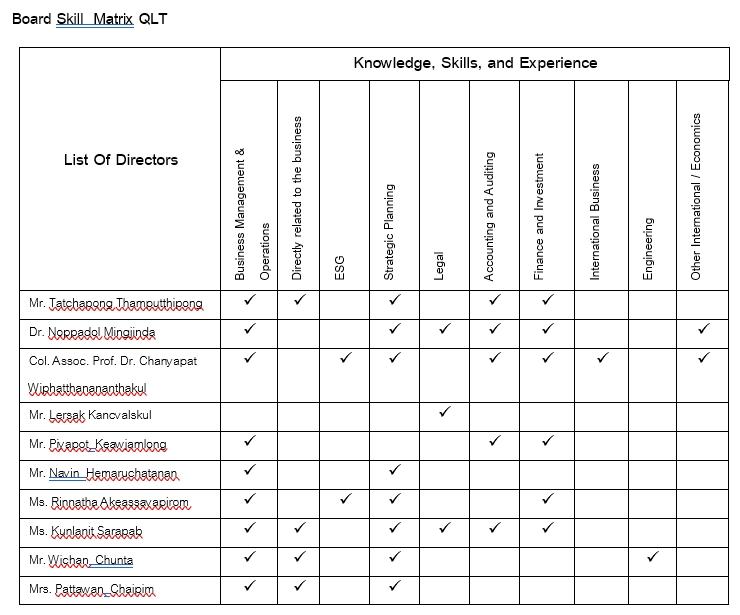
| Nomination of Directors | Policies and Practices Regarding Directors The Board of Directors comprises qualified individuals with diverse knowledge, abilities, and experience from various professions, including engineering, management, and other fields beneficial to the Company's operations. They maintain independence in decision-making for the utmost benefit of the Company and its shareholders. The Board of Directors participates in defining the Company's vision, mission, ethics, goals, policies, business plans, long-term strategies, and annual budget, entrusting the management to present these. The Board of Directors provides feedback and discusses with the management to achieve mutual agreement, as well as overseeing the management's efficient execution of the business plan and budget. It also ensures regular processes for evaluating the adequacy of internal control systems, financial reporting, and performance monitoring. In the year 2568 (2025), the Board of Directors Meeting No. 4/2568, held on March 6, 2568 (2025), reviewed the Company's vision, mission, strategies, goals, and business direction, as well as important policies to ensure their suitability and alignment with business operations under good corporate governance principles, such as the corporate governance policy and anti-corruption policy. The Board found them still appropriate for current business operations and assigned the management to implement them and report on their performance at quarterly Board of Directors meetings. Board Structure The Company has stipulated that the composition of the Board of Directors must include at least one-third of the total number of directors as independent directors, but not less than 3 persons. These independent directors serve as representatives of minority shareholders, performing duties to audit and balance the Company's various business operations to ensure they are conducted correctly, fairly, and for the utmost benefit of shareholders. The Board of Directors promotes diversity in its structure, ensuring it comprises qualified individuals with diverse knowledge and abilities, experience, expertise beneficial to business operations, and a commitment to integrity and honesty, without limitations based on gender, race, religion, age, professional skills, or other specific qualifications. Currently, the Board of Directors consists of 10 qualified members, a number suitable for the Company and effective in performing their duties. It comprises 4 executive directors, 6 non-executive and non-independent directors, and 5 non-executive directors who qualify as independent directors, which is more than one-third of the total Board members. Audit Committee: The Company has an Audit Committee consisting of 3 independent directors. They perform specific duties and propose matters for the Board of Directors' consideration and acknowledgment. The Audit Committee has rights and duties as defined in its scope of authority and responsibilities. At least 1 audit committee member must possess sufficient accounting knowledge and experience to review the reliability of the Company's financial statements. The audit committee member with knowledge and experience in reviewing the Company's financial statements is: 1. Mr. Tatchapong Thamputthipong And there is 1 audit committee member with knowledge and experience in the Company's business, namely: 1. Mr. Tatchapong Thamputthipong The Board of Directors has appointed a Company Secretary to fulfill duties and responsibilities under the Securities and Exchange Act. However, in the future, the Company may establish other sub-committees to perform assigned tasks to alleviate the administrative burden of the Board of Directors. Board Diversity Policy The Board of Directors is well aware of the benefits of Board Diversity and considers it a crucial factor in enhancing the efficiency of the Board's decision-making and operations. The Company has a gender diversity ratio on its Board, with male directors accounting for 60% and female directors for 40%. This diversity is not limited to gender but also includes age, educational background, professional experience, skills, and knowledge. Therefore, the nomination and appointment of company directors will be based on knowledge and abilities, using selection criteria that consider the benefits of diversity. As of December 31, 2568 (2025), the Board of Directors consists of a total of 10 members, who are generally recognized as capable individuals. They possess diversity in gender, skills, professions, expertise, and experience beneficial to the execution of business strategies and the Company's success. The directors possess skills aligned with the company's business strategy, as detailed in the Board Skills Matrix, and demonstrate diversity in education and experience, without any other limitations. The Board Skills Matrix can be summarized as follows:
Nevertheless, the Board of Directors still mandates that each year, at least three-fourths of all directors must attend training to develop and enhance their knowledge, understanding, and roles as directors, as well as other courses related to maintaining their status as company directors and in sub-committees. The goal is for all directors to have knowledge of ESG, which is a concept for sustainable organizational development, as it is a policy that the Company prioritizes. In the past year 2568 (2025), two directors completed ESG training and gained ESG knowledge. The Company aims to further promote directors' knowledge in AI and information technology by the year 2570 (2027). Term of Office for Directors At every Annual General Meeting of Shareholders, one-third, or the number closest to one-third, of the directors in office at that time shall retire. A retiring director may be considered for re-nomination to the shareholders' meeting for re-election to office. For audit committee members, each audit committee member shall serve a term of 3 years. An audit committee member whose term expires in accordance with the Company's regulations may be reappointed. In the event that an audit committee position becomes vacant for any reason other than the expiration of the term, the Board of Directors shall appoint a qualified person as an audit committee member to ensure the number of audit committee members meets the Board's requirements. The person appointed as a replacement audit committee member may only serve for the remainder of the term of the audit committee member they are replacing. The Company has established qualifications for individuals to serve as truly independent directors, suitable for the Company's specific characteristics. This independence must comply with the criteria set by the SEC and the Stock Exchange of Thailand. The Company stipulates that independent directors may serve for a continuous term not exceeding 9 years from the date of their initial appointment as independent directors. To ensure clarity in roles and responsibilities, the Company has clearly defined the duties of the Chairman and directors, to prevent any single individual from having unlimited authority. The person holding the position of Chairman is separated from the person holding the position of Chief Executive Officer, and an independent director is designated to hold the position of Chairman. As of the year 2568 (2025), no independent director has served for more than 9 years. Nomination and Appointment of Directors and Top Executives Nomination and Appointment of Independent Directors The Company has defined independent directors in accordance with the minimum requirements of the Securities and Exchange Commission and the Stock Exchange of Thailand, as per the Capital Market Supervisory Board Notification No. TorJor. 4/2552 dated February 20, 2552, regarding the qualifications of independent directors, namely: An Independent Director refers to an external director who is independent in expressing opinions, acts to protect the interests of all shareholders equally, and can help prevent transactions involving conflicts of interest between the Company and related persons. The qualifications for holding the position are as follows: 1. Holding shares not exceeding 1% of the total voting shares of the Company, its subsidiaries, major shareholders, or controlling persons of the Company. This includes shares held by related persons of that independent director. 2. Not being or having been a director involved in management, an employee, a salaried advisor, or a controlling person of the Company, its subsidiaries, major shareholders, or controlling persons of the Company, unless such characteristics have ceased for at least 2 years. 3. Not being a person related by blood or legal registration as a father, mother, spouse, sibling, or child, including the spouse of a child of another director, executive, major shareholder, controlling person, or a person to be nominated as a director, executive, or controlling person of the Company or its subsidiaries. 4. Not having or having had a business relationship with the Company, its subsidiaries, major shareholders, or controlling persons of the Company in a manner that may impede their independent judgment, and not being or having been a significant shareholder or controlling person of those having a business relationship with the Company, its subsidiaries, major shareholders, or controlling persons of the Company, unless such characteristics have ceased for at least 2 years. 5. Not being or having been an auditor of the Company, its subsidiaries, major shareholders, or controlling persons of the Company, and not being a significant shareholder, controlling person, or partner of an auditing firm to which an auditor of the Company, its subsidiaries, major shareholders, or controlling persons of the Company belongs, unless such characteristics have ceased for at least 2 years. 6. Not being or having been a professional service provider, including legal or financial advisors, who received service fees exceeding 2 million Baht per year from the Company, its subsidiaries, major shareholders, or controlling persons of the Company, and not being a significant shareholder, controlling person, or partner of such professional service provider, unless such characteristics have ceased for at least 2 years. 7. Not being a director appointed as a representative of a director of the Company, a major shareholder, or a shareholder related to a major shareholder. 8. Not engaging in a business of the same nature that significantly competes with the business of the Company or its subsidiaries, or not being a significant partner in a partnership, or a director involved in the management of employees, salaried advisors, or holding more than 1% of the total voting shares of another company that engages in a business of the same nature and significantly competes with the business of the Company or its subsidiaries. 9. Possessing no other characteristics that would prevent them from providing independent opinions regarding the Company's operations. After being appointed as an independent director with characteristics conforming to clauses 1 to 9, the independent director may be assigned by the Board of Directors to make decisions regarding the operations of the Company, its parent company, subsidiaries, associated companies, fellow subsidiaries, major shareholders, or controlling persons of the Company, through collective decision-making. The Board of Directors comprises 5 independent directors, who are knowledgeable, capable individuals, and genuinely independent in performing their duties, for example, having no business relationship with the Company and no other relationships that could influence their independent judgment and performance of duties. Term of Office for Independent Directors The Board of Directors stipulates that independent directors shall serve a term of 3 years, with one-third of the total number of directors rotating out of office at each term's expiration. Upon completion of their term, directors may be considered for re-nomination to the Annual General Meeting of Shareholders for re-election as company directors and may return to office. However, independent directors may serve for a maximum of 3 terms or 9 years, calculated from the date of their appointment and the Company's listing on the Stock Exchange. As of the year 2568 (2025), no independent director of the Company has served for more than 9 years. Nomination and Appointment of Directors and Top Executives The nomination of qualified individuals to serve as directors whose terms have expired or in other cases is proposed to the Board of Directors for consideration of the nominated individuals for election and submission to shareholders for approval. The Company's selection process for qualified individuals is based on expertise, vision, leadership, integrity, transparent work history, and the ability to express independent opinions. The selection of individuals for directorship must align with the Company's business strategies. The Company has prepared a Board Skill Matrix to support the consideration of director nominations, focusing on necessary knowledge and expertise currently lacking on the Board. The Board will consider qualified individuals for directorship from nominations by shareholders for election as directors, nominations by external consultants (Professional Search Firm), nominations from a Director Pool database, or nominations through other processes deemed appropriate by the Board. The current directors of the Company, who have been nominated, are aligned with the Company's business strategies. The composition, nomination, appointment, removal, or termination of directorships of the Company are stipulated in the Company's Articles of Association, the key points of which can be summarized as follows: 1. The Board of Directors shall consist of no less than 7 but no more than 15 directors, elected by the shareholders' meeting. There must be at least 3 directors who are audit committee members. Furthermore, at least half of the total number of directors must reside in Thailand. 2. The shareholders' meeting shall elect directors according to the following criteria and methods: 1. Each shareholder shall have one vote per one share. 2. Each shareholder shall cast all available votes for the election of one or more persons as directors. In the case of electing multiple persons as directors, votes cannot be split among them in varying proportions. 3. The persons receiving the highest votes in descending order shall be elected as directors, equal to the number of directors to be appointed or elected at that time. In the event that persons elected in the subsequent order receive an equal number of votes exceeding the number of directors to be appointed or elected at that time, the Chairman of the meeting shall cast the deciding vote. 3. At every Annual General Meeting of Shareholders, one-third (1/3) of the directors in office at that time shall retire. If the number of directors cannot be divided exactly into three parts, the number closest to one-third shall retire. Directors who must retire in the first and second years after the Company's registration shall be determined by drawing lots. For subsequent years, the director who has been in office for the longest period shall retire. A retiring director may be re-elected to office. 4. Any director wishing to resign from their position shall submit a resignation letter to the Company. The resignation shall be effective from the date the resignation letter reaches the Company. 5. For a resolution to remove any director from office before the expiration of their term, the votes must be no less than three-fourths of the number of shareholders attending the meeting and having the right to vote, and the combined shares must be no less than half of the total shares held by shareholders attending the meeting and having the right to vote. At the Annual General Meeting of Shareholders for the year 2568 (2025), the Company provided an opportunity for shareholders to nominate qualified individuals for directorship from October 1, 2567 (2024) to December 31, 2567 (2024). Upon the deadline, it was found that shareholders nominated two individuals for consideration of appointment as company directors: 1. Mr. Somchan Laptikultham and 2. Mr. Monthanat Laptikultham. The Company considered the names proposed by shareholders; however, since both individuals mentioned above, who were nominated for directorship, had already been appointed as company directors by a resolution of the Extraordinary General Meeting of Shareholders No. 1/2568 on January 13, 2568 (2025), and were still serving as directors on the date of the aforementioned Annual General Meeting of Shareholders for the year 2568 (2025), their names were not resubmitted for further consideration. Nomination and Appointment of Audit Committee Members The Company's Audit Committee must consist of independent directors appointed by the Board of Directors and possessing qualifications as prescribed by the Securities and Exchange Act of Thailand, including announcements, regulations, and/or rules of the Stock Exchange of Thailand. The committee shall comprise no less than 3 members. At least 1 audit committee member must possess knowledge in accounting and finance. Nomination and Appointment of the Risk Management Committee The Risk Management Committee is appointed by the Board of Directors to define and establish overall risk management strategies. Additionally, the Risk Management Committee is responsible for developing and regularly reviewing the risk management system to align with established policies. The Board of Directors shall appoint one member of the Risk Management Committee as its Chairman, with qualifications as prescribed by the Securities and Exchange Act of Thailand, including announcements, regulations, and/or rules of the Stock Exchange of Thailand. Nomination and Appointment of the Nomination and Remuneration Committee The Board of Directors proposes the appointment of the Nomination and Remuneration Committee, elected from a suitable number of independent directors and executives, to ensure independence in nominating directors and determining appropriate remuneration for the Company. The Board of Directors shall appoint one member of the Nomination and Remuneration Committee as its Chairman, with qualifications as prescribed by the Securities and Exchange Act of Thailand, including announcements, regulations, and/or rules of the Stock Exchange of Thailand. Nomination and Appointment of the Executive Committee The Board of Directors proposes the appointment of the Executive Committee, elected from a suitable number of directors and/or executives. The Board of Directors shall appoint one member of the Executive Committee as its Chairman. | |||||||||||||||||||||||||||||||||||||
| Determination of Director Remuneration | The Company sets appropriate compensation for directors and executives. The factors considered include alignment with the Company's performance, business size, roles and responsibilities, duties, and performance of directors, the overall economic conditions, and a comparison with compensation of other companies listed on the Stock Exchange of Thailand and within the same industry group, as well as being sufficient to attract and retain qualified directors within the Company. The compensation for the Company's directors must be approved by the Company's shareholders' meeting. As for executive compensation, it will be in accordance with the principles and policies set by the Board of Directors, taking into account their duties, responsibilities, performance, and the Company's overall performance. The Company's Executive Compensation The Company considers executive compensation based on fairness and appropriateness to the assigned duties and responsibilities, aligned with the Company's performance. Furthermore, the performance of each executive is evaluated against their job objectives, in alignment with the Company's vision, mission, and annual strategic plan, to serve as an incentive for executives to foster stability and long-term growth for the organization. Executive Compensation The Nomination and Remuneration Committee and the Board of Directors consider and approve based on the performance evaluation of the top executives, which is determined by their performance in alignment with the Company's vision, mission, and annual strategic plan. Short-term compensation consists of salaries and other benefits. Long-term compensation, such as bonuses, depends on long-term performance. | |||||||||||||||||||||||||||||||||||||
| Independence of the Board of Directors from the Management | Roles and Responsibilities of the Chairman of the Board of Directors The Chairman of the Board of Directors has the role and duty to oversee the performance of the directors, encourage directors to perform their duties within the scope of authority, duties, and responsibilities of the Board of Directors and relevant laws, including adhering to good corporate governance principles, in line with good governance and established policies. The Chairman ensures that all directors participate in meetings, promotes an organizational culture with ethics and good corporate governance, and fosters good relationships between executive and non-executive directors, and between the Board of Directors and management, to ensure that Board meetings are efficient, resolutions are clear, and meeting minutes are accurately and completely recorded, including serving as the chairman of shareholders' meetings. It should also be stipulated that the Chairman of the Board should be a different person from the Chief Executive Officer. and the Chairman of the Executive Board, to create a balance between management and good corporate governance. Roles, Duties, and Responsibilities of the Board of Directors The company requires its directors to comply with the Code of Best Practices for Directors of Listed Companies, as guided by the Stock Exchange of Thailand. The Board of Directors must understand and be aware of their roles, duties, and responsibilities, and must perform their duties in accordance with the law, the company's objectives, and its articles of association. as well as resolutions made with honesty and integrity, prioritizing the interests of the company and its shareholders. The Board of Directors is responsible for setting policies, business objectives, business plans, and the company's budget, and for overseeing management to ensure operations align with the established policies, objectives, plans, and budget efficiently and effectively, for the utmost benefit of the company and its shareholders as a whole. In the past year 2025, the company's directors have complied with the Code of Best Practices for Directors of Listed Companies, as guided by the Stock Exchange of Thailand, with integrity, prudence, and circumspection, for the utmost benefit of the company and its shareholders as a whole. There have been no instances of fines, accusations, or civil actions by regulatory bodies such as the Securities and Exchange Commission (SEC), the Stock Exchange of Thailand (SET), or the National Anti-Corruption Commission (NACC) regarding corruption offenses. | |||||||||||||||||||||||||||||||||||||
| Director Development | The Company encourages its Board of Directors and executives to attend seminars on courses beneficial to their duties. The courses that directors should attend at a minimum are those offered by the Thai Institute of Directors (IOD), namely the Directors Certification Program (DCP), Directors Accreditation Program (DAP), or Audit Committee Program (ACP), or from relevant regulatory bodies on a regular and continuous basis. The Board of Directors has assigned the Company Secretary to coordinate with the directors to inform them of various training courses to continuously apply knowledge and experience for the Company's development. Currently, the Company has 10 directors, all of whom have completed training in courses related to their roles and duties, representing 100%. A total of 3 directors have completed the Director Certification Program (DCP), and 7 directors have completed the Director Accreditation Program (DAP). These courses are organized by the Thai Institute of Directors (IOD). In 2025, directors attended training to develop their knowledge and understanding of their roles and duties in efficient management, as follows:
Nevertheless, the Board of Directors still stipulates that each year, at least three-quarters of the entire board must attend training to develop and enhance their knowledge, understanding, and roles as directors. In 2025, 8 directors attended the training, representing 80%. New Director Orientation The Board of Directors mandates an orientation for newly appointed directors, assigning the Company Secretary to prepare company information, business overview, shareholding structure, organizational structure, director's handbook, and meeting schedule. This is to ensure new directors are aware of their roles, duties, and responsibilities, the company's corporate governance policies and practices, as well as to build understanding of the business, operations, risk management, and to clarify and answer questions, including visits to various operational units of the company to prepare them for their duties. | |||||||||||||||||||||||||||||||||||||
| Board Performance Evaluation | The Board of Directors conducts an annual self-assessment of its members, structured into three formats: 1) the entire Board, 2) individual directors, and 3) all sub-committees. This also includes an annual performance evaluation of the Chief Executive Officer and/or CEO at least once a year, allowing the Board to review performance, identify problems, and address obstacles encountered during the past year, with the aim of resolving issues and enhancing operational efficiency. The Board's performance evaluation utilizes guidelines recommended by the Stock Exchange of Thailand, adapted to suit the Company's business operations, as follows:
The evaluation process is as follows: 1. Conduct a performance evaluation of the entire Board of Directors at least once a year. 2. The Company Secretary summarizes and presents the results of the performance evaluation of the Board of Directors to the Board meeting for consideration of the evaluation results and guidelines for improving operational efficiency. 2. The performance evaluation of individual directors (self-assessment) is divided into 3 main topics, namely 1. Structure and Qualifications of the Board of Directors 2. Board Meetings 3. Roles, Duties, and Responsibilities of the Board of Directors The evaluation process is as follows: 1. Each director conducts a self-assessment at least once a year. 2. The Company Secretary summarizes and presents the results of the individual performance evaluation of the Board of Directors to the Board meeting for consideration of the evaluation results and guidelines for improving operational efficiency. 3. The performance evaluation of all sub-committees is divided into 3 main topics, namely 1. Structure and Qualifications of the Board of Directors 2. Sub-Committee Meetings 3. Roles, Duties, and Responsibilities of Sub-Committees The evaluation process is as follows: 1. Conduct a performance evaluation of all sub-committees at least once a year. 2. The Company Secretary summarizes and presents the results of the performance evaluation of all sub-committees to the Board meeting for consideration of the evaluation results and guidelines for improving operational efficiency. 4 .The performance evaluation of the Chief Executive Officer and/or CEO is divided into 3 main topics, namely 1. Progress of the Work Plan • to evaluate performance against objectives and the status of planned achievements. 2. Performance Measurement • The evaluation topics include leadership, strategy formulation, strategy implementation, financial planning and performance, relationship with the Board, external relationships, administration and personnel relations, succession planning, product and service knowledge, and personal attributes. 3. Development • to assess key strengths to be maintained and areas requiring further development in the year and subsequent years. In In 2025, the performance of the Board of Directors was evaluated, encompassing assessments of the entire Board, individual self-assessments of directors, evaluations of all sub-committees, and the Chief Executive Officer (CEO). The overall evaluation results showed an average score of 97%. | |||||||||||||||||||||||||||||||||||||
| Corporate Governance of Subsidiaries and Associated Companies | The Company has consistently prioritized good corporate governance policies alongside its business operations and has established a written corporate governance policy and business ethics handbook. The objective is to govern the operations of the Company and its subsidiaries. The Board of Directors has disseminated the good corporate governance policy and business ethics to directors, executives, and employees at all levels to ensure consistent adherence. The Company believes that good corporate governance will enable it to achieve its mission. The Company's principles of good corporate governance involve overseeing the organization's operations to ensure accountability, transparency, auditability, and the creation of ethical competitiveness. Furthermore, adhering to good corporate governance principles reduces risks and builds long-term competitiveness for the organization, with a primary focus on maximizing benefits for shareholders. In the nomination and exercise of voting rights for the appointment of individuals as directors in subsidiaries, the Company's management has established procedures requiring such nominations and voting rights to be approved by the Board of Directors. Individuals appointed as directors in subsidiaries are obligated to act in the best interests of the subsidiary. The Company has stipulated that such appointed individuals must obtain approval from the Board of Directors before casting votes or exercising voting rights on significant matters at the same level that would require approval from the Board of Directors if undertaken by the Company itself. The appointment of directors as representatives in such subsidiaries is in proportion to the Company's shareholding. Furthermore, in the case of a subsidiary, the Company stipulates that individuals appointed by the Company must ensure that the subsidiary has complete and accurate regulations regarding connected transactions, acquisition or disposal of assets, or any other significant transactions of the Company. These regulations must adhere to the same disclosure and reporting principles as those of the Company. Additionally, they must oversee the collection of data and accounting records of the subsidiary to enable the Company to inspect and consolidate them for timely preparation of consolidated financial statements. Investment Policy and Management Policy for Subsidiaries and Associates. The objective is to ensure that the Group's various investment activities are systematically managed under a unified standard, with sufficient investment information for analysis, consideration, and timely decision-making according to established procedures. This includes thorough review, approval based on delegated authority, and consistent monitoring of progress and performance. Investment in subsidiaries, associates, and joint ventures. The Company has a policy of investing in subsidiaries, associates, and joint ventures to support its core operations. The Company does not set a specific investment limit for subsidiaries, associates, and joint ventures; rather, the investment amount depends on the necessity of registered capital and the amount of funds required for the operation of each business. The Company's management policy for subsidiaries, associates, and joint ventures varies according to the nature of the business and investment strategy. Management is decentralized, but key policies are controlled. The Company will appoint directors, executives, or representatives to serve as directors to jointly formulate business policies in line with the Company's main policies and to participate in the management of subsidiaries. For associates and joint ventures where the Company has a relatively small shareholding, the Company may only appoint directors, executives, or representatives to serve as directors to jointly formulate key policies. Scope of control/participation in policy formulation. The scope of control over subsidiaries, associates, and joint ventures depends on the shareholding proportion. If the shareholding proportion is high, the Company will have a greater scope of control over management than companies with lower shareholding proportions. However, generally, the Company participates in policy formulation by appointing directors, executives, and representatives of the Company to serve as directors in subsidiaries, associates, and joint ventures to jointly determine the policies of those companies. Appointment of Company representatives as directors in subsidiaries, associates, and joint ventures. The Company may appoint its executives, employees, or qualified representatives to serve as directors in subsidiaries, associates, and joint ventures to participate in management, formulate key policies, or nominate individuals for election as independent directors of those companies. Control and monitoring of investments in subsidiaries, associates, and controlled entities.
| |||||||||||||||||||||||||||||||||||||
| Other guidelines regarding the board of directors | Board Meeting | Board meetings are conducted in accordance with the Company's Articles of Association, laws pertaining to public limited companies, and regulations of the Stock Exchange of Thailand. Additional special meetings are convened as necessary. The Board of Directors is scheduled to meet at least 6 times a year to effectively monitor the Company's operations. The Audit Committee meets at least 4 times a year. The Board of Directors has set the meeting schedule for the second week of the month in which quarterly financial statements are due, aligning with the submission deadlines to the Stock Exchange of Thailand. The Company Secretary prepares and submits the annual meeting calendar to the Board of Directors in advance, by November of each year, to allow directors to allocate their time and schedule meetings in advance. This schedule does not include extraordinary meetings. The Company will send out meeting notices, agendas, and meeting documents to the directors at least 7 days prior to the meeting to allow the directors sufficient time to review the information before attending the meeting. However, in urgent cases where it is necessary to protect the Company's interests, the meeting may be called by other means and scheduled sooner. Furthermore, two or more directors may request the Chairman to convene a Board meeting. Should two or more directors make such a request, the Chairman shall schedule the meeting within 14 days from the date of the request. For Board of Directors meetings, a quorum shall consist of no less than two-thirds of the total number of directors present, enabling the Board to pass resolutions. Furthermore, each director must attend at least 75% of the Board meetings held throughout the year, and the collective average attendance of all directors must be no less than 80% of all Board meetings held during the year. The Company records minutes of meetings in writing and stores the minutes approved by the Board of Directors, making them available for inspection by the Board of Directors and relevant parties. The Board of Directors has established a policy that non-executive directors should have the opportunity to meet among themselves as appropriate, or at least once a year, without the presence of executive directors or management, to discuss various issues, including those related to the Company's business, such as management strategies, sustainable growth approaches, or other matters of interest. The outcomes of such meetings shall be reported to the Chief Executive Officer. In 2025, one such meeting was held on February 25, 2025. | ||||||||||||||||||||||||||||||||||||
| Other guidelines regarding the board of directors | Committee Report | The Board of Directors is responsible for overseeing the preparation of financial reports, which include the Company's financial statements, the consolidated financial statements of the Company and its subsidiaries, and the financial information presented in Form 56-1 (One Report). These financial reports are prepared in accordance with generally accepted accounting standards in Thailand, by selecting appropriate and generally accepted accounting policies that are consistently applied, and by exercising careful judgment in their preparation, and ensuring adequate disclosure of significant information in the notes to the financial statements. | ||||||||||||||||||||||||||||||||||||
| Other guidelines regarding the board of directors | Policy on Directors, Chief Executive Officer, and Senior Executives Holding Directorships in Other Companies | To comply with good corporate governance principles and the recommendations of the Stock Exchange of Thailand, the Board of Directors has therefore established a policy limiting the number of directorships held by directors in other listed companies to no more than 5. As of December 31, 2025, none of the 10 company directors hold more than 5 directorships in other listed companies. Furthermore, the Board of Directors has stipulated that the Chief Executive Officer and senior executives may hold directorships in other companies as necessary, without affecting the duties and responsibilities of the Company, provided that prior approval is obtained from the Board of Directors or an authorized approver. | ||||||||||||||||||||||||||||||||||||
| Other guidelines regarding the board of directors | Succession Planning | To ensure the continuity of the Company's operations, the Board of Directors has recognized the necessity and importance of succession planning for senior management positions and positions identified as Critical Positions. This is based on criteria such as age approaching retirement (60 years), difficulty in finding replacements in the labor market, or a tendency to be in high demand in the market. Therefore, a succession plan has been established for the positions of Chief Executive Officer, Deputy Chief Executive Officer, and Assistant Chief Executive Officer, to recruit suitable individuals for these positions, considering their knowledge, abilities, experience, vision, leadership, integrity, and qualifications as specified for holding key jobs. It also includes regular reviews to align with current circumstances. For senior management positions, the Company has developed a succession plan for executives from the department manager level upwards. It identifies individuals who will assume these roles. In cases where no immediate replacement is available, a system for developing subordinate personnel has been established to prepare them, as well as external recruitment. This is to maintain confidence among investors, the organization, and employees that the Company's operations will be seamlessly continued. the scope which will be reviewed annually. In the year 2025, Management reported on the succession plan for senior executives and the Chief Executive Officer to the Nomination and Remuneration Committee once. | ||||||||||||||||||||||||||||||||||||
| Other guidelines regarding the board of directors | Disclosure of Interests | The Board of Directors has established guidelines regarding the reporting of interests by the company's directors and executives to ensure transparency and prevent potential conflicts of interest, as follows:
In the past year 2025, all directors prepared their conflict of interest reports, and the company found no actions violating the conflict of interest policy. |
Code of Conduct
Has a Business Code of Conduct
Yes
Code of Conduct Description
The Company encourages its directors, executives, and employees to operate and make decisions in all Company businesses with transparency, integrity, in compliance with the law, and adhering to ethical principles. To this end, a Business Code of Conduct manual has been developed as an integral part of the corporate governance policy, serving as a guideline and standard for the operations of all directors, executives, and employees within the organization. Strict adherence and continuous oversight are maintained. The "Corporate Governance Policy" and "Business Code of Conduct Manual" have been published on the Company's website (www.qualitechplc.com) to inform external parties. Furthermore, internal training and communication are conducted to ensure that the Company's directors, executives, and employees are fully aware and can implement these principles correctly.
In 2025, no reports or related information concerning violations of the Company's Business Code of Conduct were identified.
Code of Conduct Practices
| Guideline | Other — Please Specify | Detail |
|---|---|---|
| Other guidelines related to business code of conduct | The company's Code of Conduct. | Details can be found at the following link: https://investor.qualitechplc.com/corporate-governance/ |
Promoting Compliance with the Code of Conduct
Promotes Compliance by Directors, Executives and Employees
Yes
Description
Monitoring and evaluation process for compliance with good corporate governance
The Board has established a process for monitoring and evaluating compliance with good corporate governance, including the Company's ethics and business conduct, as follows:
-
Monitoring and evaluation by Dharmniti Internal Audit Co., Ltd., the Company's internal auditor
-
Self-assessment by executives and employees
The Company has communicated to executives and employees at the management level and above to supervise and monitor their subordinates, and they must immediately report to their supervisors through the chain of command if any non-compliance with established policies is found. Furthermore, these policies are incorporated as part of the annual performance evaluation for executives and employees.
Anti-Corruption Networks & Projects
Joined or Declared Intent to Join Anti-Corruption Networks
Yes
Networks & Projects Joined
| Network / Project | CAC Certified |
|---|---|
| Thai Private Sector Collective Action Against Corruption: CAC | Y |
| United Nations Global Compact (UNGC) | |
| Participation of anti-Corruption networks and initiatives |
Material Changes & Developments in CG
Reviewed the CG Policy or Board Charter in the Past Year
Yes
Material Changes or Developments in the Past Year
Yes
Policy Review — Description
Qualitech Public Company Limited ("the Company") recognizes the importance of good corporate governance and has consistently cooperated well in complying with various regulations with relevant agencies, such as the Stock Exchange of Thailand (SET), the Securities and Exchange Commission (SEC), the Thai Listed Companies Association (TLCA), the Thai Investors Association, the Thai Institute of Directors Association (IOD), and the Private Sector Collective Action Against Corruption (CAC), among others. This is because we have always believed that merely building trust or achieving good financial performance may not be sufficient for a good listed company. Instead, the company must be able to adapt to changes in the business environment and maintain good relationships with stakeholders in all aspects of its business. This enables the company to grow and survive, achieve good long-term performance, be credible to shareholders and stakeholders, and contribute to creating sustainable value for the enterprise, aligning with the expectations of the business sector, investors, the capital market, and society as a whole.
The company has annually reviewed its corporate governance policy through the Board of Directors to ensure alignment with the 8 principles of good corporate governance for listed companies, CG Code 2560. In the past year, the company reviewed various matters such as the good corporate governance policy, the business ethics handbook, the Board charter, and various other policies. The Corporate Secretary and Investor Relations Department is assigned to coordinate, supervise, and monitor these matters.
Implements the CG Code for Listed Companies
Yes
Other CG Performance & Outcomes
In the past year, the company received evaluations from relevant agencies as follows:
-
In 2025, Qualitech Public Company Limited received a rating from the SET ESG Ratings for Sustainable Stocks project for the year 2025 at level A.
-
Results of the evaluation for the "Quality Assessment of Annual General Meeting Management" project Annual 2025, organized by the Thai Investors Association, which was assigned by the Securities and Exchange Commission (SEC). The company received an evaluation score of 100% (5 stars).
-
Results of the evaluation for the "Thai Listed Companies Corporate Governance Survey Project" (for the year 2025, organized by the Thai Institute of Directors Association (IOD)). The company received an evaluation score of 87%, which is considered very good. The company has incorporated recommendations for improving corporate governance under the CGR project in various categories to enhance and develop its corporate governance, aiming to further elevate the company's corporate governance standards.
-
The company received certification from the Private Sector Collective Action Coalition Against Corruption (CAC) on July 22, 2016, and has continuously renewed its certification. On December 31, 2025, the company received its 4th certification renewal. The certification is valid for 3 years and will expire in December 2028.